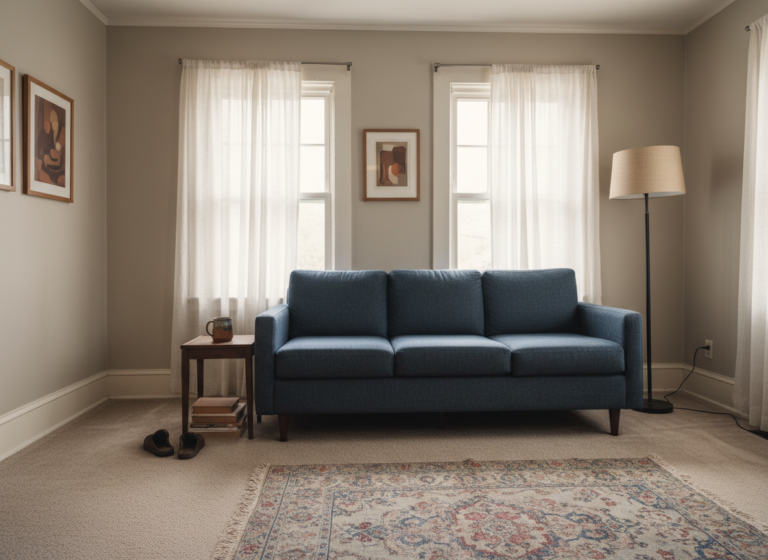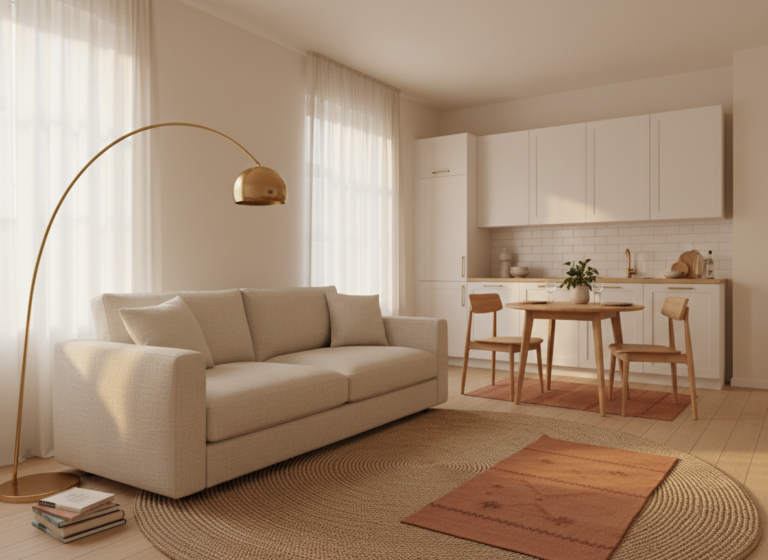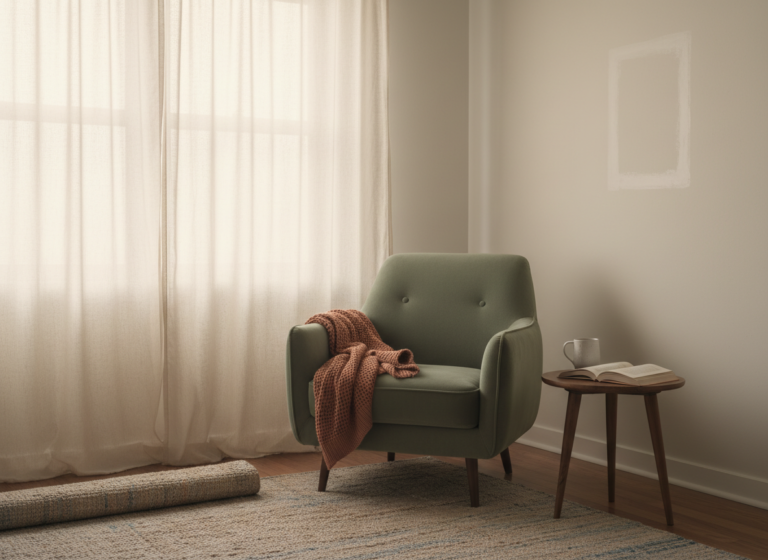
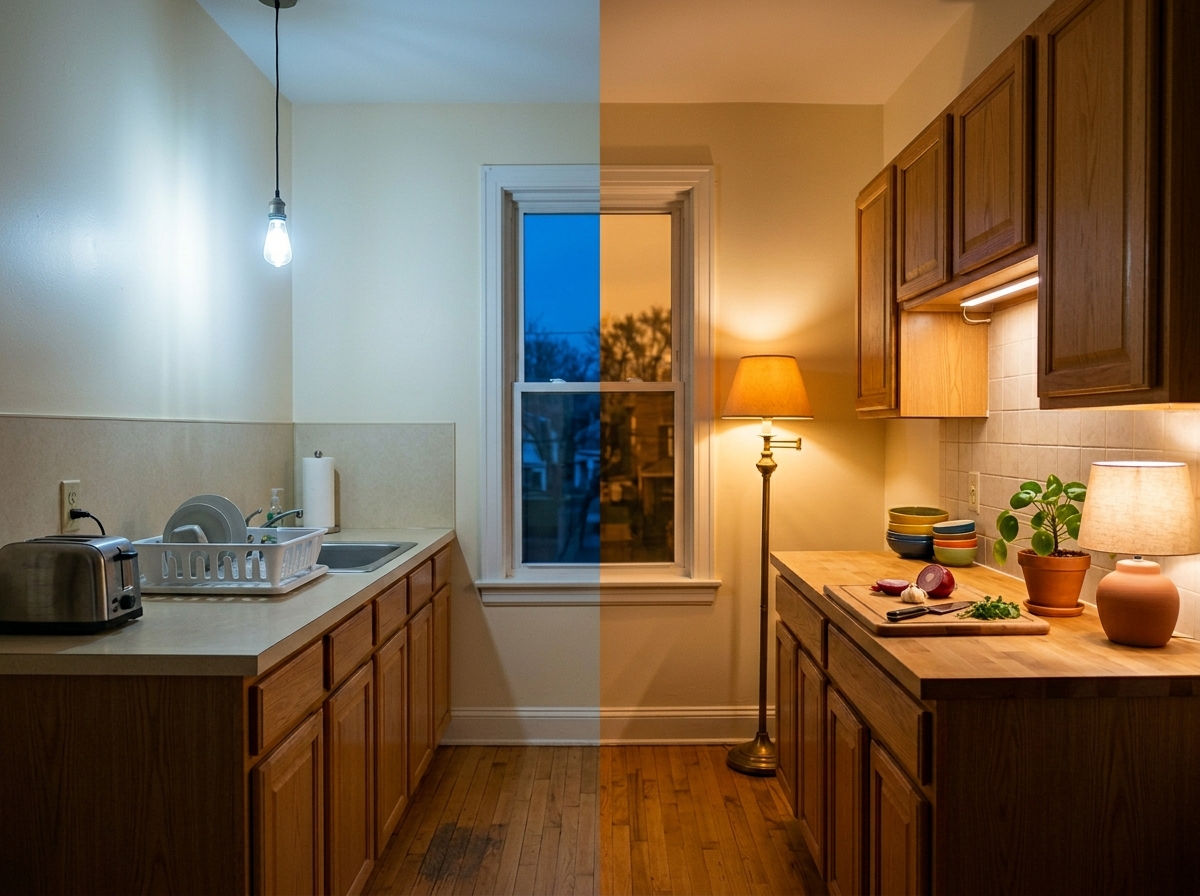
Most renter-friendly lighting advice still tells you to swap that bulb. Warmer Kelvin, smarter dimmable, color-changing app. The bulb isn’t the problem. The plan is. A room lit by one ceiling fixture will always look like a rental, because that’s exactly what one ceiling fixture looks like. The fix isn’t a better bulb. It’s more lights — added in layers, on extension cords and plug-in fixtures, without touching a wire or drilling a hole.
Why one overhead light always loses
The single overhead bulb is the lighting equivalent of a fluorescent strip in a parking garage. It casts light down from one point, which means it flattens everything below it, kills shadow depth, and concentrates the brightest spot exactly where nobody wants to stand. Look at any room in a magazine that doesn’t read “rental.” Count the light sources. You’ll find three, four, sometimes six. Never one.
The reason this isn’t obvious from inside the rental is that the lighting we grew up with as kids was almost always overhead. Bedroom ceiling fan. Kitchen flush mount. Bathroom strip. We learned that “lighting” means “the switch by the door.” A whole industry of floor lamps, plug-in sconces, picture lights, and under-cabinet strips exists specifically to undo that one-switch default. It just doesn’t get used much in rentals because most renters assume adding lights means calling an electrician. It doesn’t. Every single layer below plugs into a standard outlet.
The three layers — translated for renters
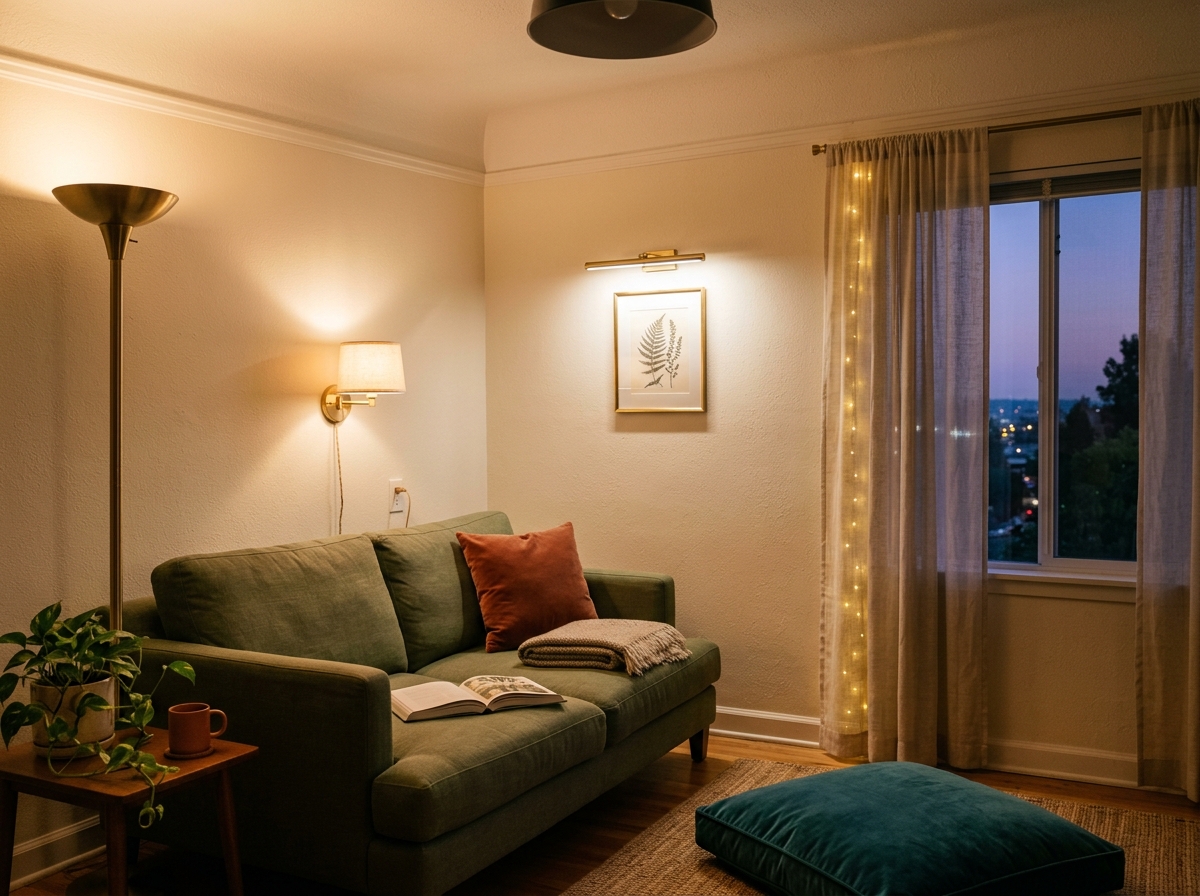
Ambient — replaces “the room is bright enough”
The base fill. Not the overhead — the overhead is too central and too bright. A tall floor lamp in a corner pointed at the ceiling, or a torchière, bounces light off the white-painted ceiling and washes the whole room evenly. Two corner lamps in a living room beats one ceiling fixture every time, because the light is coming from the sides instead of straight down. Cost range $40–120 per lamp. Zero install. Plugs into the wall.
Task — the layer renters skip and shouldn’t
Light aimed at the surface where you actually do something. The kitchen counter where you chop. The desk where you work. The bedside where you read. Stick-on rechargeable LED bars under cabinets, a clamp lamp on a desk edge, a plug-in bedside sconce. Task lighting is the single biggest visible upgrade in a rental, because it puts brightness where the room is used and lets the rest of the room sit dimmer and warmer. Cost range $15–50 per piece.
Accent — what the room reads as at night
The small lights you barely register but that change the mood. A picture light on a piece of wall art. A small lamp on a bookshelf. String lights tucked behind a curtain. The accent layer doesn’t light the room — it gives the room something to look at after dark. This is the layer that makes a rental photograph well, even though it’s the smallest dollar spend. Cost range $10–40 per piece.
The trick with the three-layer model is that you don’t need all three in every room. A bedroom needs ambient + a bedside task light, and often skips accent. A kitchen needs task on the counter and the existing overhead doing ambient duty. A living room is where all three earn their keep. The point isn’t filling a quota. It’s never being stuck with only one switch deciding the whole mood.
The renter’s no-rewire kit
Every piece below plugs into a standard outlet, attaches without drilling, and comes off the wall without leaving anything for the move-out inspection to score against. None of it needs an electrician, a landlord email, or a deposit conversation. Prices are 2026 ranges from the usual suspects (IKEA, Target, Amazon basics), not designer markup.
| Piece | What it does | Install | Price |
|---|---|---|---|
| Floor torchière (uplight) | Bounces ambient light off the ceiling — replaces the overhead | Plug in. Done. | $40–80 |
| Plug-in wall sconce with cord | Reading light beside the bed without drilling a junction box | Adhesive base or single nail; cord runs to outlet | $30–60 |
| Stick-on rechargeable LED bar | Under-cabinet task lighting on a kitchen counter | 3M adhesive strip; magnetic refill | $15–35 |
| Clamp work lamp | Desk task light that doesn’t need desk real estate | Clamps to shelf or desk edge | $20–40 |
| Picture light (battery) | Accent over a framed print — no wiring run needed | Adhesive bracket; takes AA batteries | $25–45 |
| Smart bulb in any existing lamp | Color temperature on a schedule — warm at night, cool by day | Screw into the lamp you already own | $10–20 |
| Plug-in dimmer for any lamp | Turns any non-dimmable lamp into a dimmable one | Inline between plug and outlet | $15–25 |
The full kit (three lamps, two task lights, one accent) runs about $200 across a one-bedroom. That’s the entire lighting budget. You will spend more on a single ceiling fixture from a design store than the whole renter’s kit costs, and the renter’s kit lights three rooms instead of one. (For the broader framework behind why we layer at all, the existing post on how to layer lighting in an apartment has the apartment-agnostic version. This post is the rental-constraint version of the same thinking.)
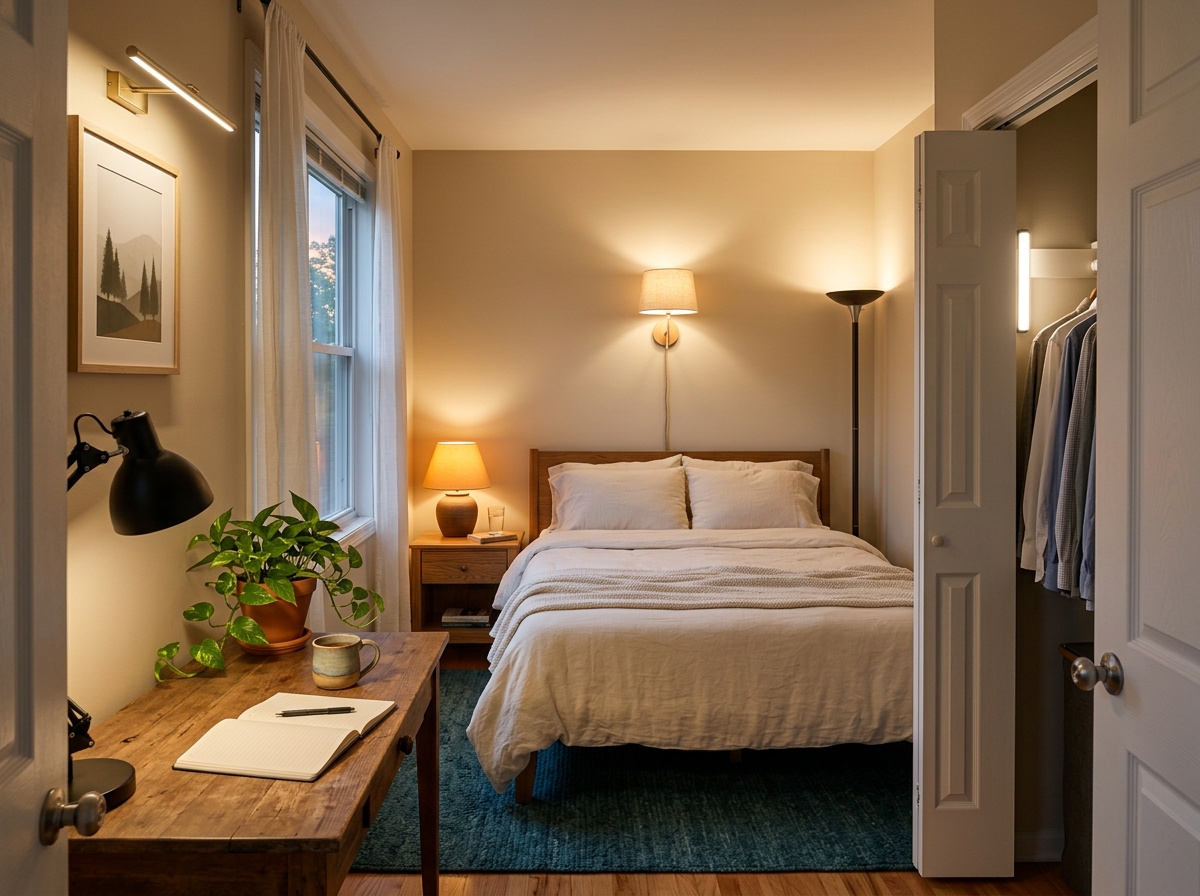
Putting it together — a sample one-bedroom
- Living room. Two floor lamps in opposing corners (ambient), one small table lamp on the side table next to the sofa (accent), smart bulb in the table lamp for warm-dimming after 9 pm. Overhead stays off most evenings.
- Bedroom. One plug-in wall sconce above the bed on the cord-and-adhesive mount (task), one floor lamp by the dresser pointed up (ambient). Overhead used only when getting dressed.
- Kitchen. Two stick-on LED bars under the upper cabinets (task), warm-temperature smart bulb swapped into the existing overhead. The overhead now does ambient duty instead of fluorescent-cafeteria duty.
- Hallway / entry. A small clamp lamp on the bookshelf by the door, pointed at the wall. One accent light. That’s the entire hallway lighting plan and it’s enough.
Back to 7:42 on that Tuesday. Same kitchen, two months later: the overhead is off. The two under-cabinet strips are warming the counter where the chopping happens. The smart bulb in the existing pendant is dimmed to a candle-equivalent and reading amber. The whole room looks like a kitchen someone chose to live in, not a kitchen the building rented out. Nothing in the room is wired differently than the day I moved in. The plan changed, not the wiring.