A budget is the wrong word for what decorating a rental actually is. The word implies suppression: how little can you spend before something snaps. The honest version is the opposite. Decorating a rental over a year is an allocation problem, not a restriction problem, and the renters who get it right are the ones who decide before they shop where each dollar is supposed to live and how long that thing is supposed to stay there.
Most advice on decorating on a budget treats the budget as a single ceiling. Set the number, divide by rooms, shop until it’s spent. The math works on paper and falls apart in the apartment because the line items aren’t all doing the same job. Some of what you buy stays with the apartment when the lease ends. Some of it goes with you. Without naming the difference at purchase time, every receipt is just a receipt, and the budget shrinks against an undefined goal.
The budget question hides the real one
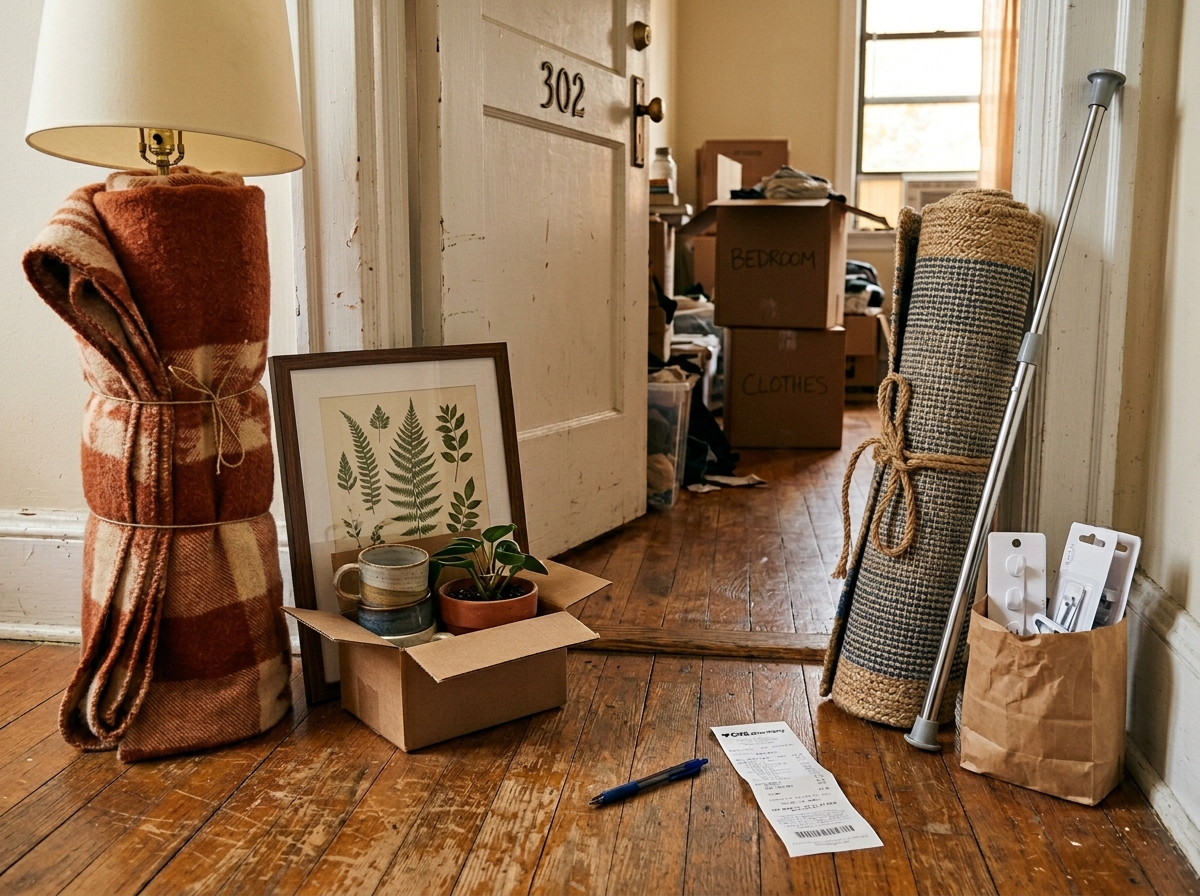
The question most renters ask is how much should I spend on this apartment? The better question is how much of this should outlive the apartment? Those are different problems with different answers.
A rental is, by lease length, a one-to-three-year operating system. The decor that lives inside it splits into two kinds. The first kind belongs to the apartment: curtain rods cut to a window that won’t be your next window, a rug sized for a living room that won’t be your next living room, the over-door hook that the next renter will quietly inherit. The second kind belongs to you: a floor lamp you’ll keep using for the next decade, a print you’ll re-hang in every place you live, a small set of ceramics, a wool blanket. Same shopping trip, same checkout line. Totally different horizons.
When the two get pooled in one budget line, spending defaults to the apartment category, because that’s what “rental shopping” feels like at the store. The temp side over-spends. The permanent side under-spends. A year in, the apartment looks fine and somehow nothing in it feels yours.
Three weeks into the first apartment I set up after a long move, the rug from Wayfair was the third-largest item on the receipt. Within a year I’d given it away to a friend with a wider living room. The rug was perfectly good. It just didn’t fit any room I’d ever live in again. The two warm-toned floor lamps from the same shopping week, paid for one Saturday and not thought about much afterward, moved twice with me and are still in service today. Same week, same checkout line. Totally different cost-per-year. The rug was the budget mistake. The lamps weren’t.
The two-budget split: what comes with you, what doesn’t
The fix is structural, not behavioral. Split the budget the way you’ll physically split your belongings on the last day of the lease. Two columns. The split decides the spending logic, not just the tracking.
The permanent column gets quality. Lighting in particular. A pair of warm 2700K floor lamps that move with you to the next place cost roughly the same as a pair of cheap ones in two-year terms; the cheap pair gets replaced once mid-lease, the quality pair lasts ten years across four apartments. The same logic holds for one piece of art, one rug if it fits more than this room, one ceramic or wood piece you actually love. Spending more per item is correct here, because the cost-per-year is the lowest number on the receipt.
The temporary column gets functional and cheap. The window treatment that fits this apartment’s odd-sized windows. The shower caddy. The shoe rack that won’t fit the next entryway. These should be cheap, and they should be cheap deliberately. There is no return on over-investing in the parts of the apartment that do not follow you out the door.
The trap most renters fall into is the middle category: items that could be either, but get bought as if they were permanent and turn out to be temporary. The fix is naming the category at purchase time, not after. The rough split that works for most renters in their first or second apartment is around 65% permanent, 35% temporary. The temp percentage rises in odd-shaped apartments and falls in apartments closer to standard dimensions. The point isn’t the percentage. The point is the line.
| Room | Permanent (comes with you) | Temporary (stays with the apartment) |
|---|---|---|
| Living room | Two warm-toned floor lamps. One area rug at a size that fits more than one room. One framed print you actually chose. | Curtain rod cut to this window. Couch-fit throw pillows. Side table sized to the awkward corner. |
| Bedroom | Bedding you actually like the feel of. One mirror or piece of art. A bedside lamp. | Bedskirt that hides a non-matching frame. Stick-on closet hooks. A sheet-blocker for the odd window. |
| Kitchen | Knives, a board, one wood piece, the ceramic mugs you reach for daily. | Drawer organizers cut to this kitchen. Tension rods. Counter caddy. |
The table is not the prescription. The prescription is the act of writing each line into the right column before you buy it. After a few months of doing that, the category choice becomes faster than the price comparison.
The 12-month rhythm: order matters more than amount
Even with the split done correctly, order matters more than amount. The mistake most renters make in month one is buying in the order of “what’s easiest to photograph done” — usually pillows, throws, prints. The mistake hides because the soft photographable layer makes the apartment look finished in month one and feel undone for the rest of the lease.
The order that compounds:
- Months 1–3 · Light. The things that determine how the apartment feels at night. Warm 2700K bulbs in every fixture. At least two lamps per main room. Curtains hung high and wide, on rods you can carry to the next place. Unphotogenic phase. Highest leverage in the whole year. Mostly permanent column.
- Months 4–6 · Surface and texture. A correctly sized rug. Bedding you actually like the feel of. The two or three textile pieces that change how a room reads. Mixed: permanent on the rug and bedding, temporary on couch-fit pillows.
- Months 7–9 · Walls and personal context. The piece of art that’s no longer a placeholder. The shelf with three personal objects on it. The framed photo. Almost entirely permanent column.
- Months 10–12 · Refinement. The lamp you noticed at month five and held off on. The rug upgrade if the first one didn’t sit right. The pieces you couldn’t have known you wanted until the room was mostly assembled.
The lease ends and the permanent column walks out the door with you. Six months later, in the next apartment, half the room is already done because half of it followed you in. The year-one receipts stop being sunk cost and start reading as accumulation.
What changes when the budget is split (and tracked)
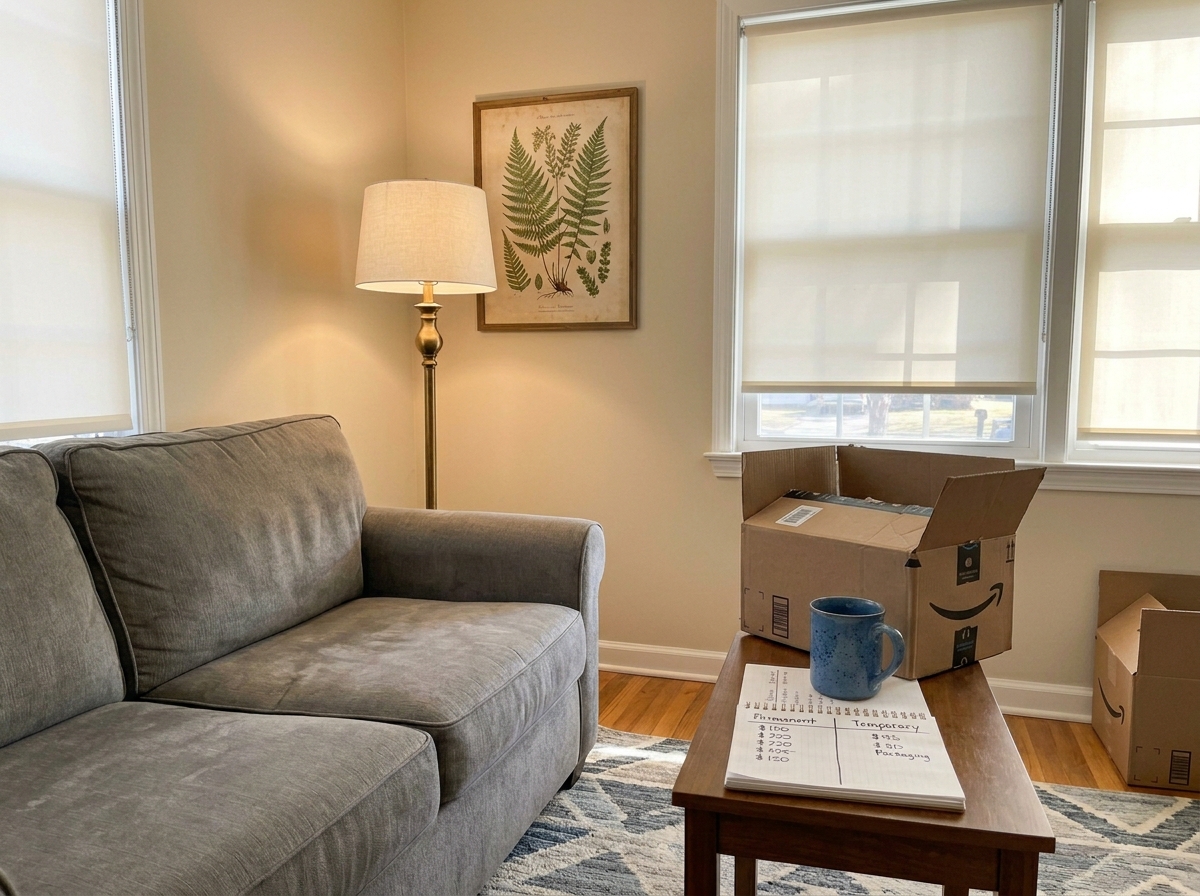
The behavioral change is downstream of the structural one. When the budget has two columns instead of one, three things shift without effort.
First, the permanent column quietly accumulates higher quality. The same $200 that would have bought two okay floor lamps and a so-so rug becomes one good floor lamp and the down payment toward a rug you keep. The decisions don’t feel different at the store. The receipt categorization makes them different.
Second, the temporary column stops growing. Most renters discover, the moment they start tracking, that they were spending more than half of their decor budget on the temp category without realizing it. Naming the category at purchase time is the only intervention required. A cap on the temp line caps the spending; nothing else has to change.
Third, the year-over-year math turns positive. In year one of a new apartment the permanent column carries about 35% of the spend and 100% of the carry-over. In year two of the same apartment the permanent column drops closer to 15%, because most of what was going to follow you already has. Total decor spend in year two, when the system is in place, lands well under half of year one. When it isn’t, year two reads flat against year one and the apartment still feels half-finished.
The compounding runs in reverse too. Five years and three apartments later, the permanent column has accumulated into a kit of decor that travels with you and works in any layout. That kit is the actual deliverable of decorating with a structured budget over a year. The temporary line is the cost of being in any particular apartment. They were never the same number. Once they’re tracked separately, the math stops feeling like restriction and starts feeling like architecture.