There are exactly four reasons a damage-free mounting method fails: the weight is wrong, the surface is wrong, the cure time was rushed, or the lease counts it as damage anyway. Most renter wall decor advice fixates on the first two and ignores the back half, which is where the deposit charges actually come from.
I learned the third one with a six-pound frame that fell off a wall at three in the morning because I’d hung it twenty minutes after pressing the strips instead of the full hour. I learned the fourth when a landlord docked forty dollars for “wall residue” from removable hooks I’d used exactly as the package described. Every method below is rated on all four: what it holds, what surface it needs, how long to wait, and how likely it is to leave a trace.

How to read this list
Each method below carries four notes: weight, surface, cure time, and deposit risk. Weight is straightforward. Surface matters more than most labels imply, because most adhesives are tested on smooth cured painted drywall; texture, semi-gloss, or paint younger than 30 days changes the math. Cure time is the gap between pressing the adhesive and hanging the object, and rushing it is the single most common reason “rated for 16 lbs” products fail at four. Deposit risk is whether the method leaves a trace when removed. Pair this list with the how-high-to-hang guide and you have the full picture.
Adhesive methods (1–5)
The widest-use category. These five cover most framed pieces under 18 pounds on smooth drywall.
1. Command Picture Hanging Strips (Large). Two strip pairs hold a framed piece up to 16 lb. Best surface: smooth painted drywall, paint cured 30+ days. Cure time: a full hour after press before hanging.
Deposit risk: Low if removed by stretching the tab straight down. Tested note: the 16-lb rating assumes two strip pairs spaced across the frame’s horizontal.
2. Command Hooks (Medium and Large). Single-point hanging up to 5 lb (medium) or 7.5 lb (large). Best for unframed wreaths, lightweight baskets, and hanging plants in plastic pots. Surface: smooth painted drywall. Cure time: 1 hour.
Deposit risk: Low.
3. Velcro Mounting Strips (3M Indoor Heavy-Duty). Holds 1–3 lb per strip pair; use multiple strips along the frame’s back edge. Surface: smooth drywall, semi-gloss tolerated. Cure time: 1 hour.
Deposit risk: Low–Medium. More residue risk than Command Strips if pulled off-axis.
4. Removable Adhesive Nails (3M Picture Hangers). A nail-shaped hook with an adhesive backing. Holds 4–5 lb. Useful when you want the visual of a nail without the hole. Surface: cured smooth drywall. Cure time: 1 hour.
Deposit risk: Low within six months; higher with longer adherence.
5. Removable Mounting Putty (Blu Tack, 3M). Reusable tacky putty for unframed paper prints, posters, and postcards. Holds only very lightweight pieces. Surface: smooth flat walls.
Deposit risk: Medium. Putty can pull paint if pressed firmly or left in place over a year.
Lean and tension methods (6–8)
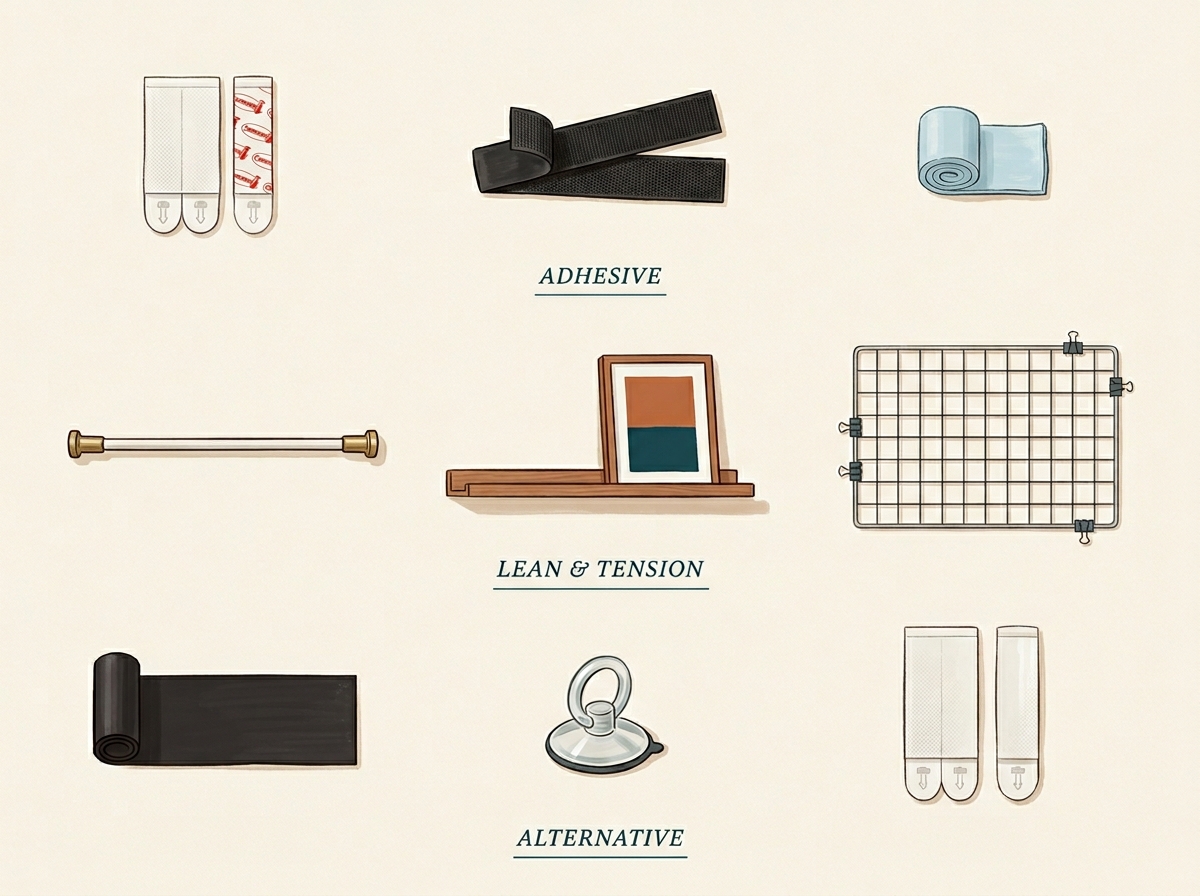
Three methods that touch the wall lightly or not at all. The lowest-risk part of the catalog.
6. Oversized Leaning Art. Canvas or framed pieces three feet tall or larger, propped against the wall with the bottom resting on the floor or on a low console. Zero adhesive, zero hardware. Works for any surface.
Deposit risk: Zero. Tested note: only stable with frames heavier than the surrounding traffic; light canvases tip if a vacuum cord brushes them.
7. Picture Ledges (propped on furniture). Small frame clusters set on a dresser, console, or bookshelf with no wall contact. The furniture carries the weight.
Deposit risk: Zero. Best for renters who move often and want art that packs without unmounting.
8. Tension Rod for Hanging Textiles. A tension rod set inside a window frame or alcove, used to hang quilts, scarves, woven pieces, or hanging plant chains. Holds up to 10 lb depending on rod diameter and span. Surface: existing jambs, no contact with the wall face.
Deposit risk: Zero.
Alternative attachment methods (9–12)
Four methods for surfaces or scenarios where standard adhesive won’t work.
9. Command Heavy-Duty Picture Hanging Strips (XL). Larger version of method one. A four-strip configuration holds up to 24 lb. Same surface and cure rules as the Large. Best for oversize frames, large unframed canvases, and 24×36 prints.
Deposit risk: Low.
10. Wire Grid Panel with Adhesive Corners. A 16×24-inch metal grid mounted with four Command Strips at the corners. Postcards, photos, polaroids, and small prints clip to the grid with binder clips or magnets. The Command Strips hold the panel; the panel holds the rotating collection.
Deposit risk: Low. Best for renters who swap wall content monthly.
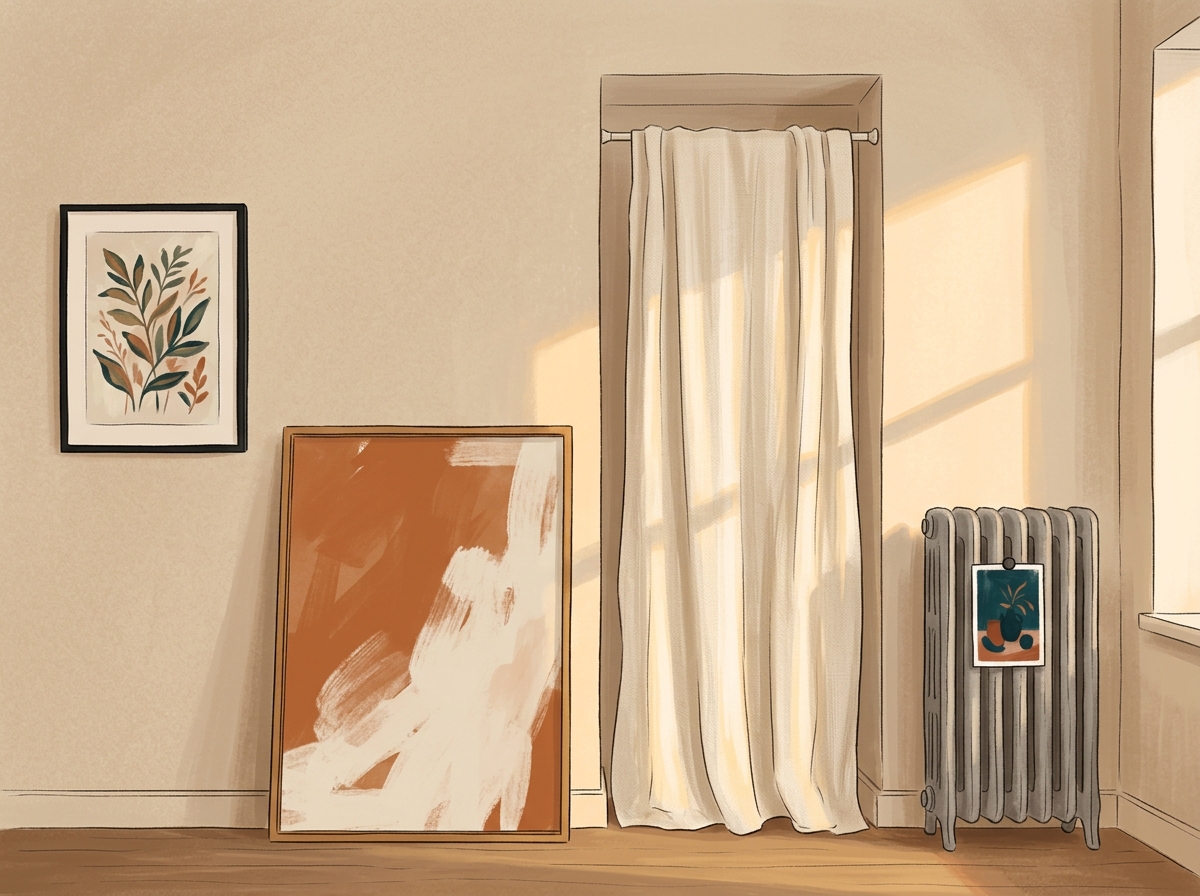
11. Magnetic Mounting (radiators, metal door frames, metal kitchen cabinets). A magnetic sheet or strip attached to the back of a lightweight print, then placed on any existing metal surface in the apartment: radiator panels, fridge sides, metal-frame interior doors, metal cabinets.
Deposit risk: Zero. Best for kitchens, bathrooms with metal cabinets, and entryway radiators.
12. Suction Cup Hooks (smooth non-porous surfaces only). Glass windows, tiled bathroom walls, glass cabinet doors, polished metal. Holds 1–3 lb depending on cup size. Cups loosen seasonally with temperature swings; recheck every 60 days.
Deposit risk: Zero on the wall. Best for hanging plants in front of bright windows and lightweight bathroom art.
The list above is what holds. The list of what doesn’t hold is roughly the same length, and it’s the one that costs deposits. Renter-Friendly Wall Decor Ideas covers what to actually put up; this list covers how to attach it without surprises. The full Visual Wiki goes deeper into surface types, cure-time tables, and the lease language that turns a “removable” product into a damage charge anyway.