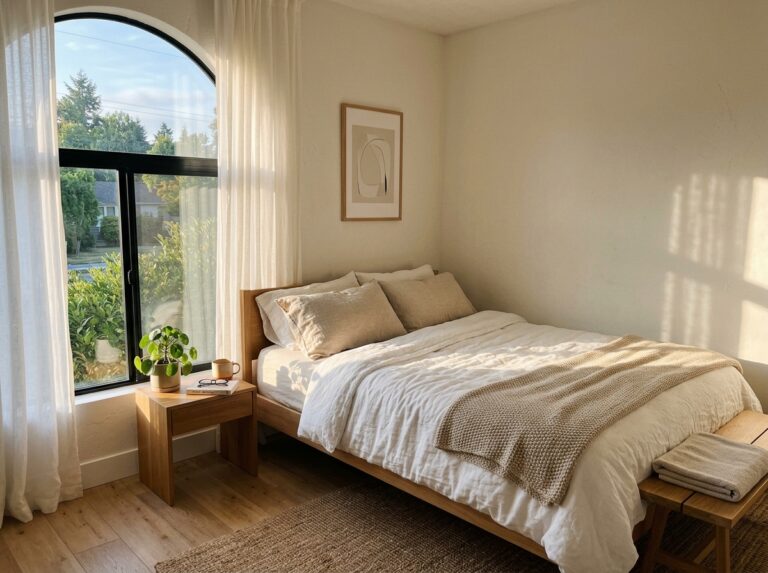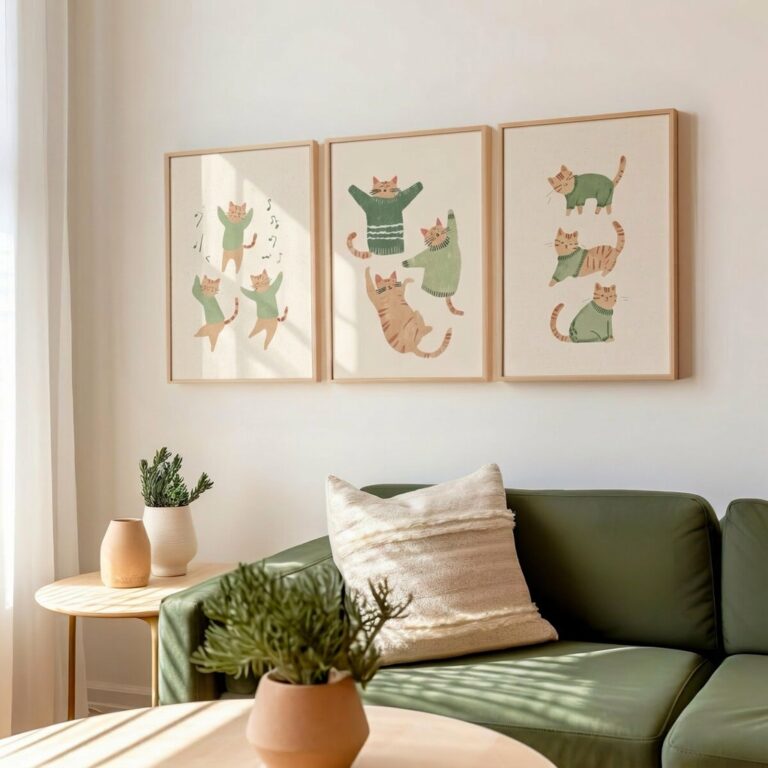
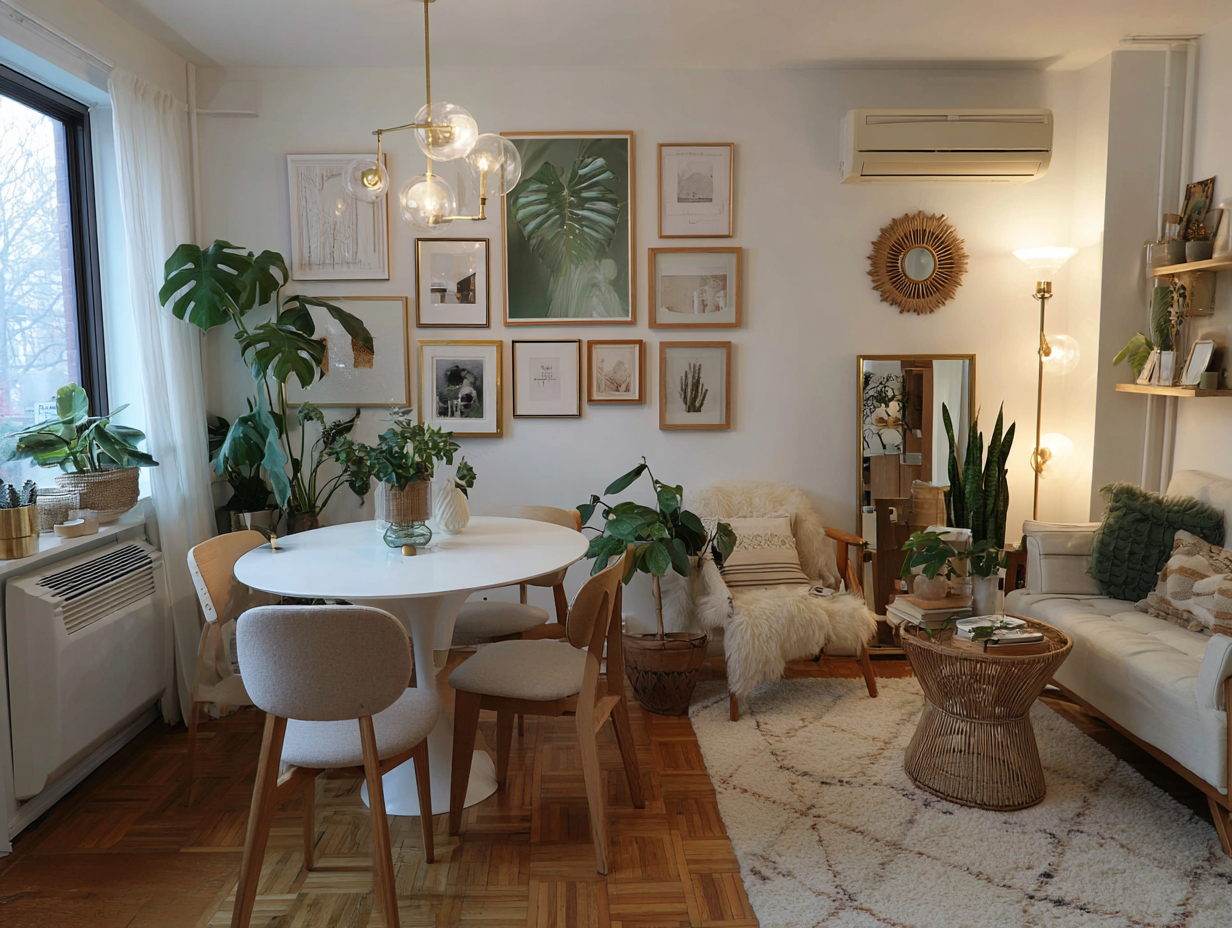
The first picture I ever hung in a rental ended up two inches too high. I’d done the math wrong on the museum rule, the one that puts the center of art at fifty-seven inches from the floor, and I hadn’t realized the formula expects you to measure from the floor to the top of the picture wire pulled taut, not to the center of the frame. The piece floated above the sofa like it was embarrassed to be there. Standard advice would have told me to fix it with a level. The actual problem was that I’d been given six different rules from six different blogs — and used the wrong one.
Most picture-hanging guides list a dozen ratios for a dozen scenarios. Above a sofa, this number. Above a console, this other number. In a stairwell, a curve. For a renter trying to put two pieces up before a friend comes over, that’s too many rules to remember and too many to argue with when one of them looks wrong. The honest version is shorter. Two numbers cover almost every hanging decision that matters in a normal apartment. Here they are.
Number one: 57 (the bare-wall rule)
On a wall with nothing under the art (a hallway, an entry, the far end of a bedroom) center the artwork at 57 inches from the floor. That’s the museum standard, pulled from the average human eye level when standing. The reason it works at all is that it’s not really about the art. It’s about where your face is when you walk into the room.
The 57-inch formula
- Measure your frame’s height in inches.
- Divide by 2. Call this H.
- From the back of the frame, measure how far the picture wire hangs down when pulled taut toward the top of the frame. Call this D.
- Mark the wall at (57 + H − D) inches from the floor. That’s where the hook goes.
- Hang. The wire catches the hook and the frame settles at exactly the right height.
If the ceiling isn’t 8 feet, 57 still wins. Tall ceilings tempt you to hang higher to “fill the wall.” Don’t. Eye level doesn’t change because your ceiling did. Hanging higher to balance the wall is the most common mistake I see in apartments with 10-foot ceilings. It puts the art into a register the eye never lands on, and the room reads as cold for reasons most people can’t name.
Number two: 8 (the over-furniture rule)
The 57 rule breaks the moment there’s a sofa, a bed, a console, or a dresser underneath the art. Now the picture has a relationship with two things, your eye and the top edge of the furniture, and the furniture wins. Center-at-57 over a sofa puts the bottom of the frame either floating four inches above the cushions or hovering an entire foot above the back, depending on the frame. Both wrong.
The fix is to ignore the 57 rule and use the second number. Hang the art so that the bottom of the frame sits 6 to 10 inches above the top of the furniture, with 8 inches as the sweet spot. That’s tight enough for the eye to read the art and furniture as one composition, loose enough that the art still looks like art and not a backsplash. For a 24-inch tall frame above a 32-inch sofa back, the math is: 32 (sofa back) + 8 (gap) + 24 (frame) = 64 inches from the floor to the top of the frame. The 57 rule would have put the center at 57 and the top at 69. Eight wins here; the piece grounds the sofa instead of floating over it.
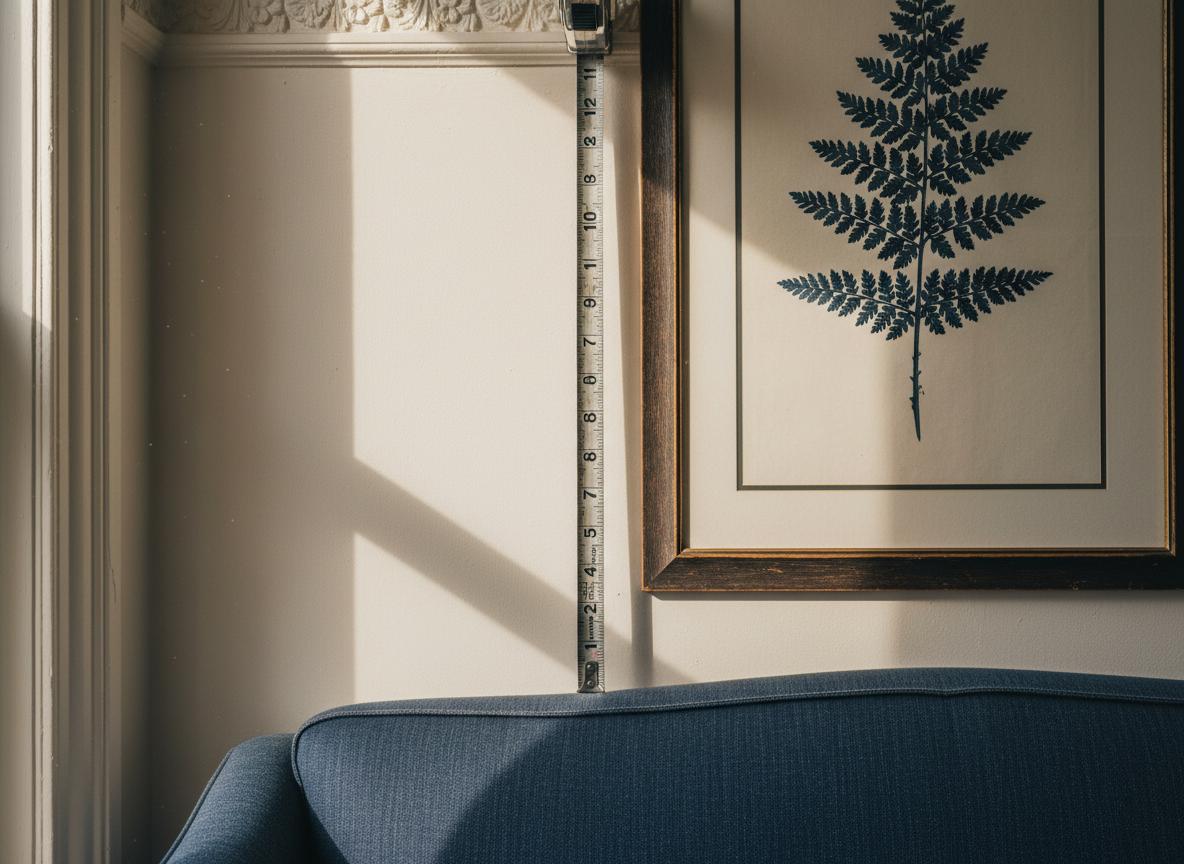
Eight inches above the back of the sofa. The gap that anchors the piece without crowding it.
When the frame is tall (over 36 inches), pull toward 6. When it’s small, push to 10. The reason this works is the same reason gravity works in interior design. A heavy piece floating high reads as nervous. A small piece grounded low reads as forgotten. Eight inches is the gap where neither happens.
Two numbers cover every single-piece decision in a rental. The math gets harder the second a second piece joins the wall. Gallery walls have a different problem, not how high but how to arrange, and the kind of pre-planning that saves a wall full of test holes is the kind of pre-planning a tool can do better than your brain at 9pm.
When the two numbers conflict (and they will)
There are walls where both numbers want to apply. A console table in an entryway, but the entryway is also a corridor your eye crosses standing up. A headboard, but with the bed pushed under a window. The general rule when the numbers fight: the furniture wins. The 57-rule is for orphan art with no anchor. The moment furniture is involved, the furniture is the anchor, and the eye-level rule loses.
| Scenario | Which number wins | Why |
|---|---|---|
| Hallway, no furniture | 57 (eye-level) | The eye is the only reference point |
| Above the sofa | 8 above the back | The sofa is the visual anchor; eye loses |
| Above a bed (no headboard) | 8 above the mattress top | The bed grounds the piece, not the eye |
| Console with a mirror | Mirror centered for a standing eye, often above 57; the 8-rule doesn’t apply | Mirrors aren’t art, they’re light |
| Stairwell wall | 57 measured from each step’s tread | The eye-level moves with you; the rule scales with the stairs |
The mirror line is the one most people miss. Mirrors aren’t read by the brain the same way framed art is. A mirror over a console reflects whatever’s across the room, so its job is bouncing light, not anchoring furniture. Center it at eye-level for a person standing in front of it (often slightly higher than 57, because consoles raise the standing reference). Treat it as a window, not a picture.
When you have more than one piece on the same wall
Two numbers will get you through almost every single-piece decision in a normal apartment. The math collapses the moment you’re hanging three or five or seven pieces together, because now the numbers stop talking to the eye and start talking to each other. A gallery wall doesn’t have a single right height. It has a center of mass that needs to land where a single artwork would (apply the 57 or the 8 to the imagined block enclosing all the frames), and a spacing between pieces that has to stay consistent. The usual gap is 2 to 3 inches between frames, but the right gap depends on the visual weight of the frames themselves.
Brown paper or kraft paper cutouts taped to the wall save the wall from a dozen test holes. Trace each frame, cut out the shapes, and rearrange the paper on the wall until the composition reads right. Mark the hook spots through the paper with a pencil, then take the paper down and hang. Renters need the no-trace step more than anyone else; one set of stud-finder dots in the wrong spot is one phone call to the landlord nobody wants.