Most bedroom wall art guides skip the plan for getting the art onto the wall without a nail. They show the print. They show the bedroom. They don’t show the package math in the hardware aisle, or the part where a framed print sits on the floor of a rental for three weeks because the renter isn’t sure whether Command Strips Large will hold real wood. Below is what those guides leave out: what works above a bed, how to size it, and how to mount it without leaving a hole behind.
Bedroom wall art is a one-wall problem
Living rooms ask you to decorate four walls. Bedrooms only ask you to decorate one. The wall above the headboard does roughly 80% of the visual work in a bedroom; every other surface is already occupied by furniture, a window, or a closet. Get the wall above the bed right and the rest of the room reads as decorated whether you hang anything else or not. That’s the reframe most bedroom guides miss.
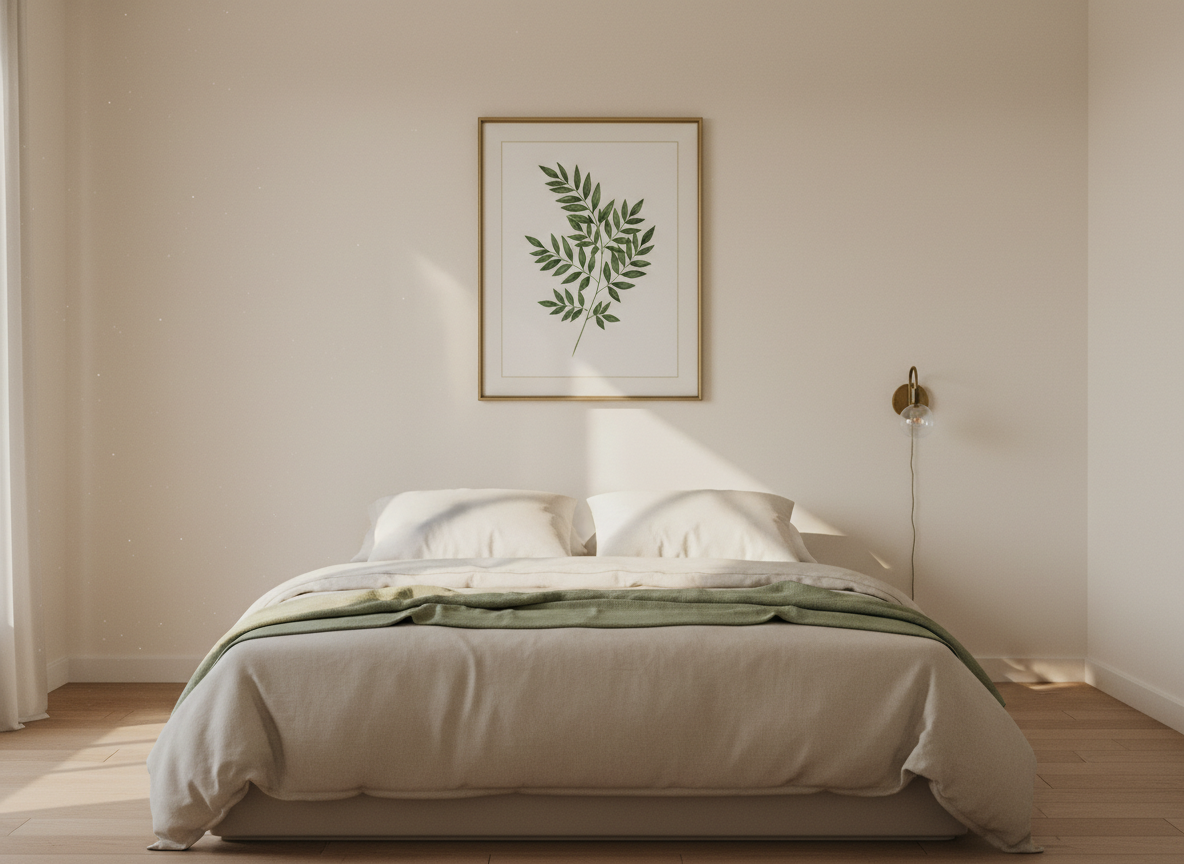
The one wall a renter has to get right. The rest of the room follows from it.
There’s a sizing rule for that one wall and it almost never appears next to bedroom wall art photos: the art should be two-thirds the width of the bed. A queen bed is sixty inches across, so the art (or the cluster of art treated as one piece) wants to be about forty inches wide. A twin is forty inches, so the art wants to be about twenty-seven. Center the piece on the bed, not on the wall. The wall stretches past the bed on both sides, and centering visually means centering over what you actually look at: the headboard.
Bottom of the frame, six to eight inches above the headboard top. Higher than that and the art floats; lower and it crowds. The single most common bedroom-wall mistake is hanging art at the same height that worked above a living-room sofa. Bedrooms are shorter rooms with the eye landing in a different spot, and they need their own number. (A longer version of the placement math, for non-bedroom walls, lives in our how-high-to-hang-art guide.)
Damage-free mounting, by what’s on the back of the frame
The package math in the Command aisle is solvable if you ignore the front of the print and look at what’s on the back. Frame weight, not frame size, is the variable that decides which mounting solution actually holds.
Under 1 lb (small unframed print, thin acrylic frame): one Command Mini hook, or a single pair of Small strips. Rated under five pounds, but never hang at the upper limit. Leave headroom.
1–4 lb (most 16×20 wood-frame prints, all 11×14 framed): two pairs of Command Large strips, one pair at each top corner. Rated to sixteen pounds total in pairs. This is the workhorse for most bedroom art.
4–15 lb (24×36 wood frame with glass, oversized prints, anything heavier than a hardcover book): Monkey Hook or no-stud J-hook through drywall. Leaves a hole roughly the diameter of a pencil tip, which fills with toothpaste or a dab of spackle at move-out. Most leases allow this.
15+ lb (oversized art with thick glass, salon clusters treated as one unit): French cleat with toggle bolts, or a low-profile picture rail screwed across the wall. These leave holes, but predictable ones, and the picture rail makes future rearranging zero-damage.
A specific scene from the same Target aisle, three apartments later: a 24×36 framed botanical at about three pounds, mounted with two pairs of Command Large strips, one pair at each top corner. It held for the entire two-year lease. The trick wasn’t a fifth strip in the middle. It was waiting the full hour the package specifies between sticking the strips to the wall and hanging the frame. That hour is the part that gets skipped, and it’s the part that decides whether the print is on the wall in the morning.
If the bedroom wall already has a nail hole left by a previous tenant, the math gets even easier: re-use the hole with a no-stud J-hook and the deposit math costs you nothing. Renter-friendly mounting isn’t only about which hardware you buy; it’s also about which existing damage you inherit. The broader version of this calculus lives in our renter-friendly wall decor playbook.
What actually looks good above a bed
Bedroom composition runs narrower than living-room composition because the room itself runs quieter. Three shapes work above a bed, and they pretty much exhaust the options that read as designed rather than busy.
A single statement piece, scaled to two-thirds of the bed width, is the simplest. One frame, one decision, one mounting solution. A botanical monogram from the Vintage Garden Letters collection in a thrifted oak frame is the version I keep coming back to: soft enough for a sleep room, structured enough to read as intentional.
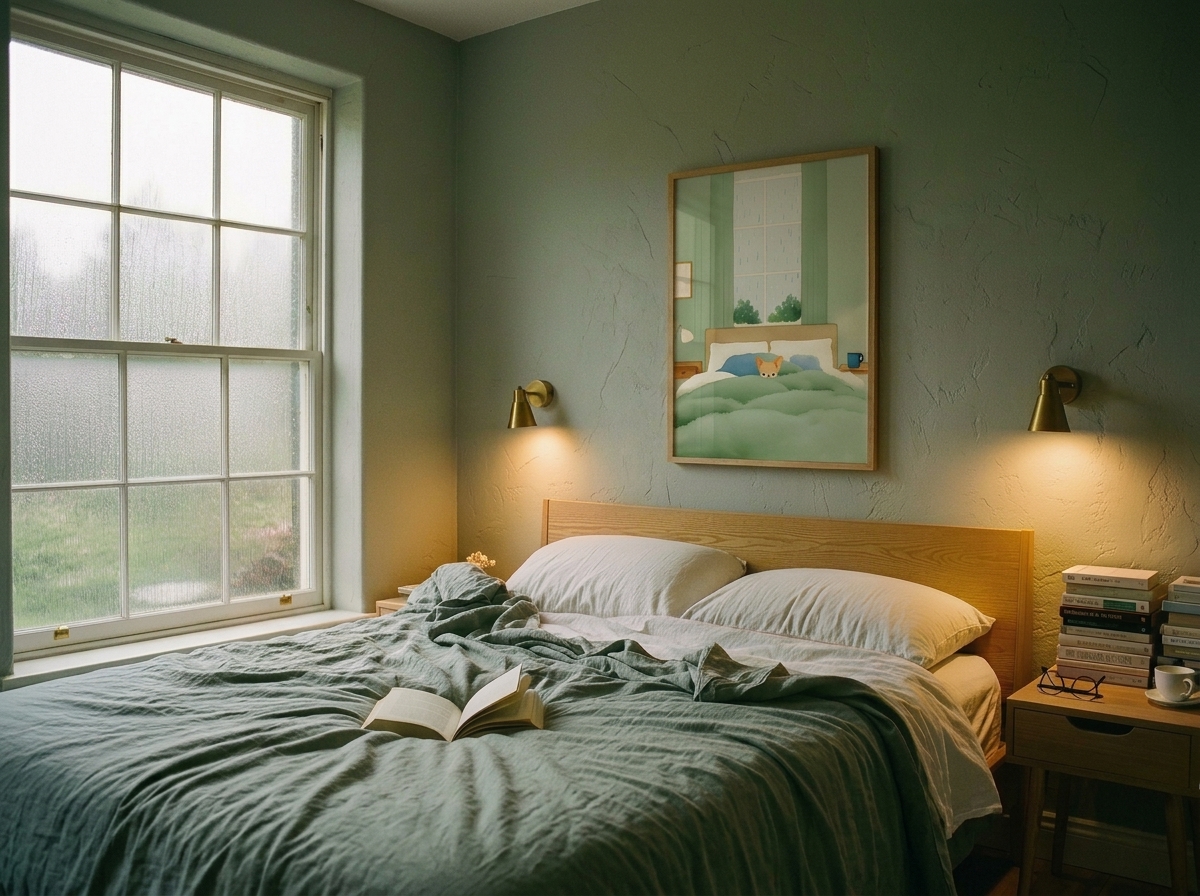
A triptych, three matched prints in a row, is the second shape that lands. Bedrooms favor the triptych for the same reason they favor matching sheets: visual symmetry calms the room down. Three soft-palette prints from the Woodland Friends collection above a queen bed read as a single forty-five-inch unit when the prints are eleven-by-fourteen and the spacing is about two inches between frames. Treat the triptych as one piece for the sizing rule: total width is what you measure against the bed.
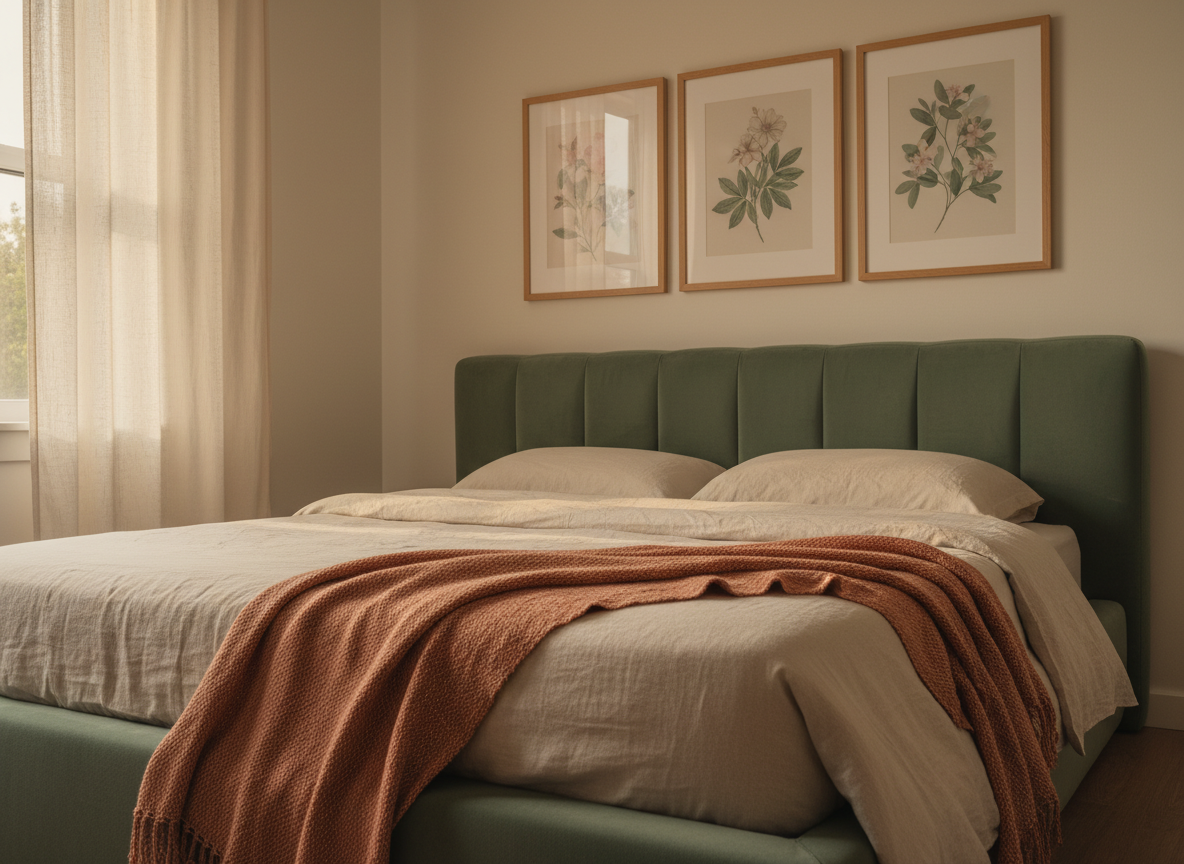
A triptych treated as one piece — total width about two-thirds of the bed below.
A salon-style cluster is the third option, and the hardest to land in a bedroom. The salon look reads as visual noise next to a place you sleep unless the cluster is restricted to one frame style and a tight palette. If a salon wall is the goal, it usually wants to live on a side wall rather than directly above the bed.
Pick the shape first, then the prints, then the mounting solution. Most renters do it in the reverse order and end up with a print they love that’s the wrong size for the wall. The full digital wall art catalog sorts by aesthetic, which is the order that protects against picking three prints that don’t actually live together on the same bedroom wall.
What bedroom wall art actually buys
One wall, one shape, one mounting decision, one quiet hour of waiting for the adhesive to set. The version of the room where this is done right doesn’t look more decorated than the version where it isn’t. It looks more settled. That difference is what bedroom wall art actually buys, and it’s the difference that costs nothing extra to the deposit on the way out.