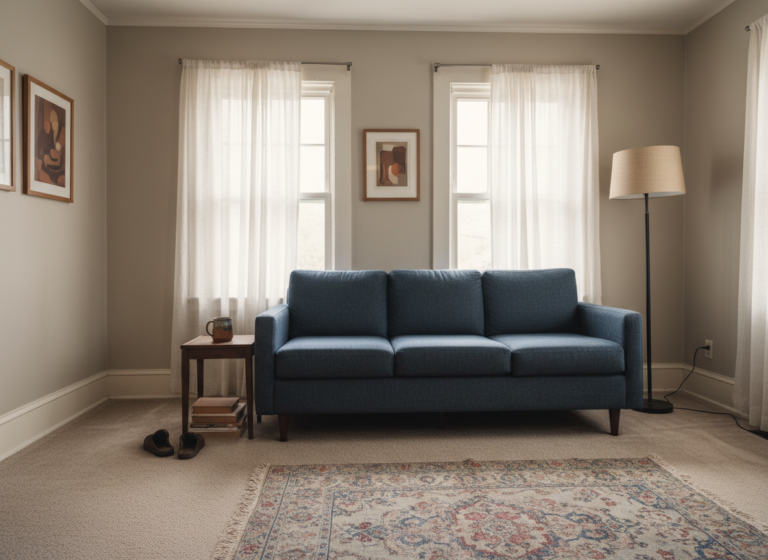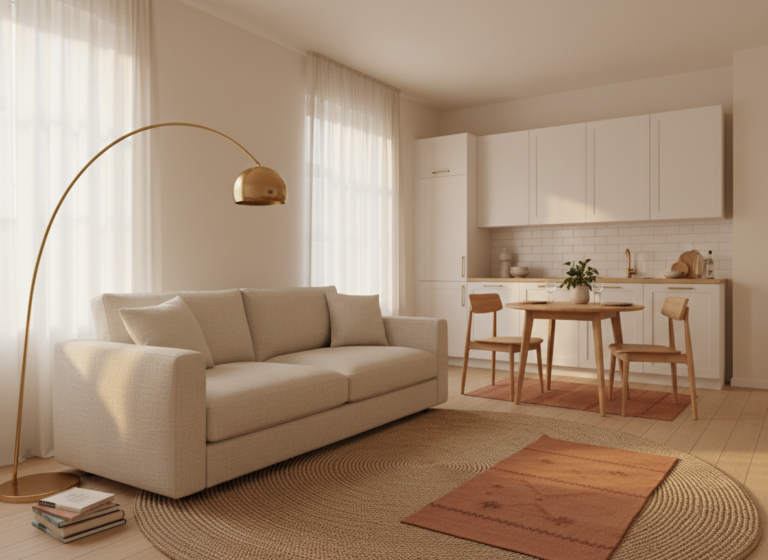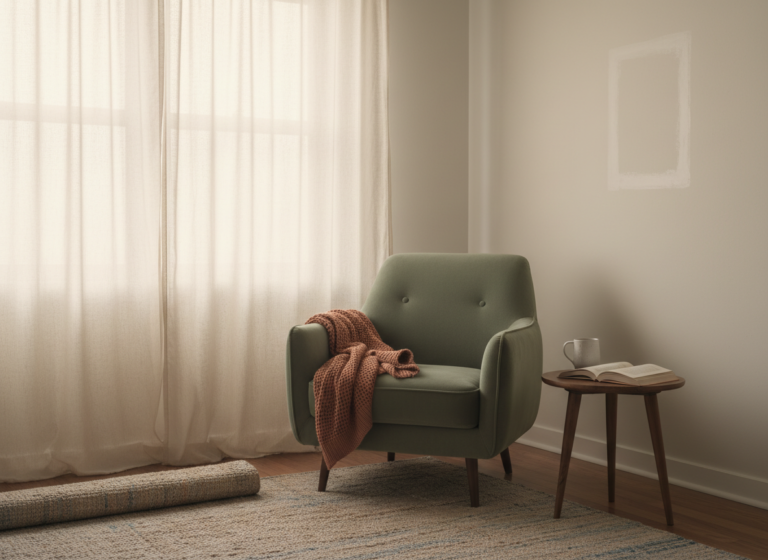

My second apartment had a popcorn ceiling, three coats of beige paint, and a leasing agent who told me on the walk-through that the security deposit would be “reviewed pretty closely” at move-out. I learned damage-free decor not as a style — as a return policy. Anything that left a mark, by the time I left, would cost me. I built a system around that constraint, surface by surface, because the alternative was decorating around the edges of a room I wasn’t allowed to actually touch.
That’s the part most renter-friendly decor advice misses. It gets sold as a vibe — neutral palettes, removable wallpaper, low-commitment Tuesday-night purchases. That’s not the renter problem. The renter problem is that every surface in your apartment has its own mounting math. Walls take weight differently than windows. Kitchens have entirely different rules than bedrooms. “Don’t damage anything” splits into seven specific decisions, and once you treat it that way — method-per-surface, not style — the whole thing gets simple.
Damage-free isn’t a style. It’s a method choice per surface.
The mistake most renters make is picking the decor first and figuring out how to mount it second. Reverse it. Start with the surface you want to change — wall, floor, window, cabinet, ceiling — and pick the reversible method for that surface. The decor comes after.
This sounds like sequencing. It isn’t. Picking method first is what stops you from buying a 14-pound framed piece for a wall that can only hold 3 pounds of adhesive, or a beautiful runner that bunches at a doorway because the floor under it isn’t level. Half of the renter decorating mistakes I’ve watched friends make trace back to this single sequencing problem.
The method library is shorter than you’d think. There are roughly seven surface decisions in a typical one-bedroom apartment, and each one has one or two correct answers if you can’t put holes in anything.
Seven surfaces, seven methods that hold.
I keep this on a single page now — partly because I’ve moved enough that I need the reminder, partly because every new apartment is its own version of the same seven problems.
| Surface | Damage-free method | Where it fails |
|---|---|---|
| Walls, heavy art (3–16 lb) | Command strips matched to weight class, applied to dust-free surface, pressed 30 seconds, left an hour before hanging | Glossy paint, textured/popcorn walls, anything heavier than the package rating |
| Walls, small décor (under 1 lb) | Museum putty or poster tape — both come off cleanly with a hair dryer | Outdoor temperature swings (putty softens above 80°F) |
| Floors (bad tile or laminate) | Large area rug with a felt grip pad, or peel-and-stick vinyl planks rated for renter use | Vinyl over old vinyl — the adhesive can bond permanently. Test in a closet first. |
| Windows (no rod brackets) | Tension rod inside the frame, or a spring rod brace; for wider windows, a no-drill bracket that grips the trim | Curtain weight — tension rods slip under heavy fabric. Linen, not blackout velvet. |
| Cabinets (kitchen, bath) | Peel-and-stick contact paper on doors and drawer fronts; cabinet handles swap-out and store the originals | Real wood absorbs adhesive — patch test before doing the whole kitchen |
| Lighting (bad overhead) | Plug-in pendant on a swag hook rated above bulb weight; floor lamps and clip-ons for the corners. Layered lighting playbook. | Hardwired fixtures — the rule on those is leave alone |
| Furniture you can’t replace | Slipcover sized to the frame, or a wraparound throw + cushions for visual override | Cheap slipcovers slide. Tuck-grip styles or velcro hold; smooth-fabric ones don’t. |
A note on the trickier ones: peel-and-stick vinyl planks are the surface where renters get burned most often, because the adhesive that lets them stay flat for two years is the same adhesive that bonds permanently to old vinyl underneath. Always test in a closet or pantry first. And on walls — if your paint is glossier than eggshell, your adhesive failure rate triples; switch to museum putty under that surface regardless of weight.
This is also the table I wish I’d had on day one of renter-friendly wall decor — the wall section is just one row of a seven-row problem.
Pick reversible by default. Decor comes second.
The reason this works isn’t that any individual method is clever. Most of these are mounting-aisle products from any hardware store. The reason it works is that you’ve committed to the question “can I take this off in under ten minutes on move-out day” before you’ve ever bought the wall thing.
A specific Tuesday recently I removed a thirty-piece grid of small framed prints from a kitchen wall — hair dryer on low, warming each adhesive strip for ten seconds, then peeling at the slow angle the package told me to. It took twenty-eight minutes. There were nine small dust outlines and zero paint scars. That’s the standard. Match it on every surface and you stop paying for someone else’s wall in the form of a withheld deposit.