The first render from a free AI interior design tool will be the best image of your apartment you’ve ever seen. The third one will hit the paywall. By the fourth, the same tool is asking for a credit card and a “starter plan” priced like a month of Spotify. Almost every product in the category follows this script. What changes is how convincingly the first three renders work as bait.
What I want to know, and what most reviews don’t tell you, is which free tiers are actually useful before the paywall, and which are pure trial bait. The renter version of that question is sharper. We don’t own the wall we’re trying to redesign. We don’t need a photoreal render of a paint color we can’t legally use. The tools selling generated images mostly aren’t built for our problem. Free is everywhere in AI decor right now. The real question is where to stop paying.
What “free” actually means in AI interior design right now
Free in this category is four different things wearing the same word. Sorting them out is the entire game.
| Pattern | What’s free | When you hit the wall |
|---|---|---|
| Render credit | Three to five renders, sometimes no account needed | The fourth render, or before you can save the third |
| Feature-locked | The renderer and a basic input form, free forever | The moment you want measurements, a shopping list, or to come back to a saved project |
| Free-with-account | The whole tool, sometimes indefinitely | Almost never. The cap is the account itself, not your wallet |
| Diagnostic, no render | The full read of your room | Almost never. The tool wasn’t built around image generation in the first place |
The first two are the most common because they convert hardest. Render-credit tools train you on the rush of the first three results, then ask you to pay to keep going. Feature-locked tools give you the basic renderer forever, but quietly route the actually-useful work (measurements, shopping lists, save-and-return projects) into the paid tier. Free-with-account tools are the friendliest of the four because the only “price” is letting them email you. And the fourth, the genuinely-useful free tier, almost always belongs to the tool that isn’t trying to sell you a render at all.
Where to stop paying: the free-tier ceiling for renters
Most renter decisions don’t need a new image. They need a verdict on the room you already have. Is this a layout problem or a lighting problem? Should the next $200 go to a rug or a lamp? Is the color story working, or is one piece dragging the whole room flat? Free AI tools handle that level of diagnostic well. Sometimes better than the paid versions, because the upgrade you’re being upsold to is usually a renderer, not a thinker.
Here’s the line I draw for myself. If a free tier gives me a structured read of my space (what’s working, what isn’t, what to do next), I stay free. If it only gives me a prettier picture of someone else’s solution, I close the tab. The last AI tool I tested gave me two renders I genuinely liked, one render that put a fireplace where my bathroom door is, and a fourth attempt that asked for a card. The paid tier almost never solves the part I’m actually stuck on. It usually solves the part I wasn’t stuck on, more glossily.
The most useful free tier I’ve used in the last year is the one that doesn’t try to generate anything at all. It looks at four categories of how your room is performing right now and ranks the next three moves you should make. No paywall, no credit meter. Just the diagnostic. That’s the kind of free tier that earns the click, because nothing on the paid tier of a render tool would have answered the same question.
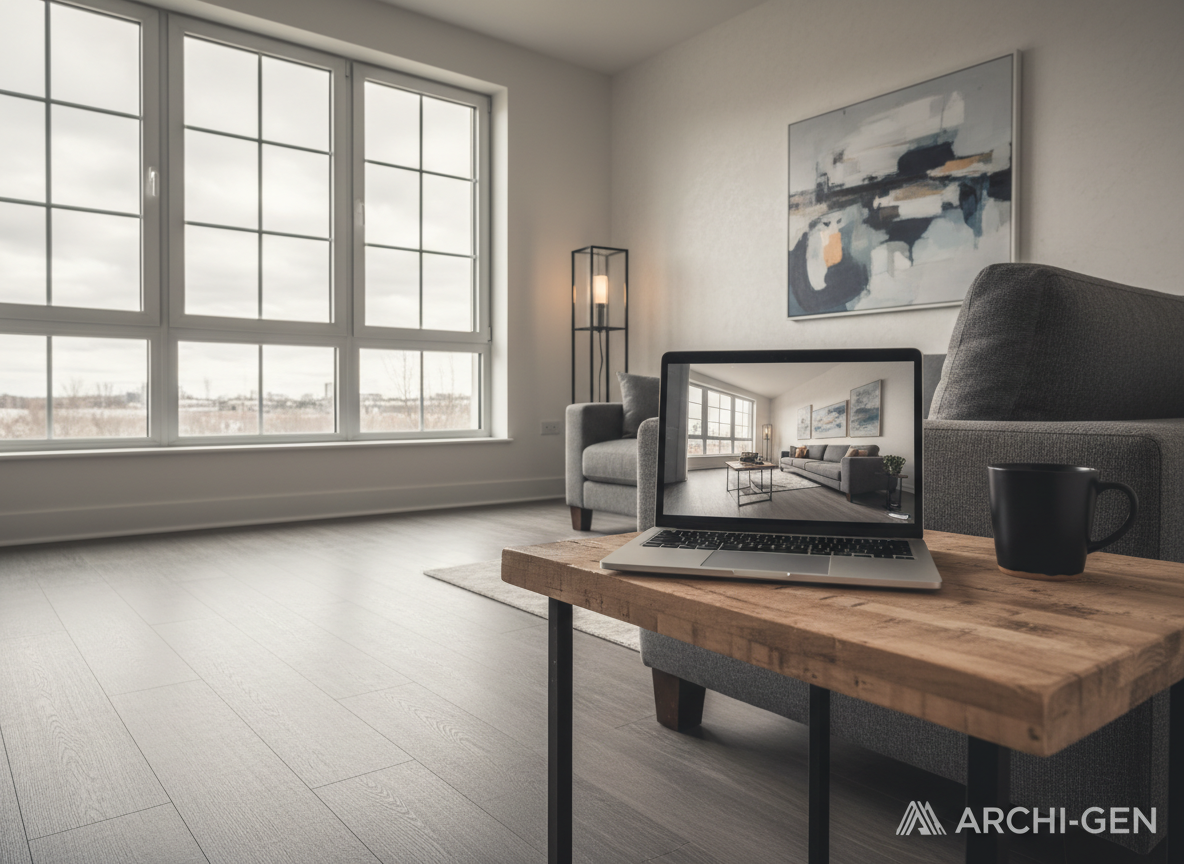
The render and the actual room. The gap between them is what every free tier quietly hides.
When the upgrade actually pays for itself
Some upgrades are worth the money. The question isn’t whether the paid tier exists. It’s whether you’d otherwise be guessing at the thing it unlocks. The short version, then the longer read.
First, is this a one-time decision or a recurring expense? Paying once for an answer about the room you’ll live in for the next three years is a different math problem than a monthly subscription you’ll still be paying after the room is done. Renters should pay for the one-time. The subscription model is built for designers running ten projects at once, not for you running one.
Second, is the paid feature solving a problem you’re actually stuck on, or one the free tier taught you to want? Most upgrades are upsells to the next render, not the next decision. If the paid tier is “more renders, prettier renders, larger renders,” but you already got your real answer from render number two, you don’t need the upgrade. You needed the diagnostic that came before it.
Third, would you act on the paid output, or save the image and unsubscribe in a month? This one matters more for renters than for anyone else. Most of what AI decor tools generate is unactionable in a rental: knocked-down walls, paint, custom built-ins, tile we’d have to refund a deposit over. If the upgrade gives you a beautiful version of something you can’t legally do, the free tier was already the ceiling.
The honest read of the AI decor stack in 2026 is that the free tier covers more than the marketing suggests. Most renters don’t need to pay for a category of tool that was built for designers and homeowners. The piece worth paying for is the one that doesn’t try to generate anything at all — the one that walks the whole room with you, asks what you can’t change, and gives you an answer instead of another image.