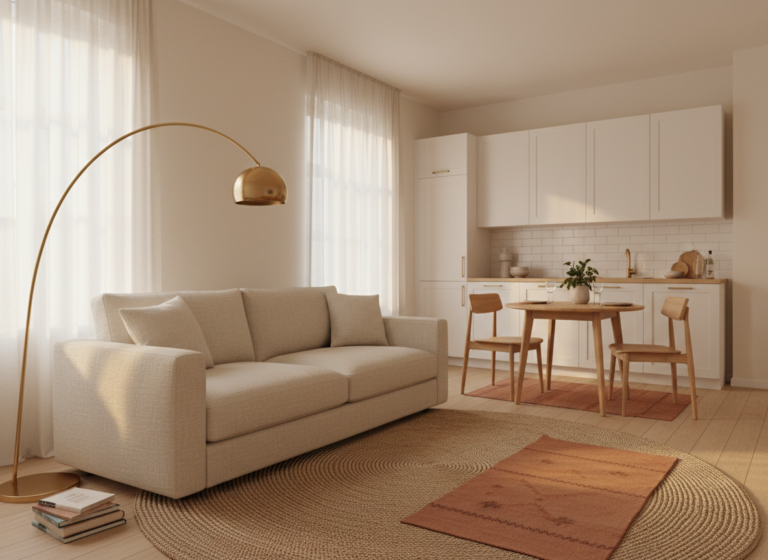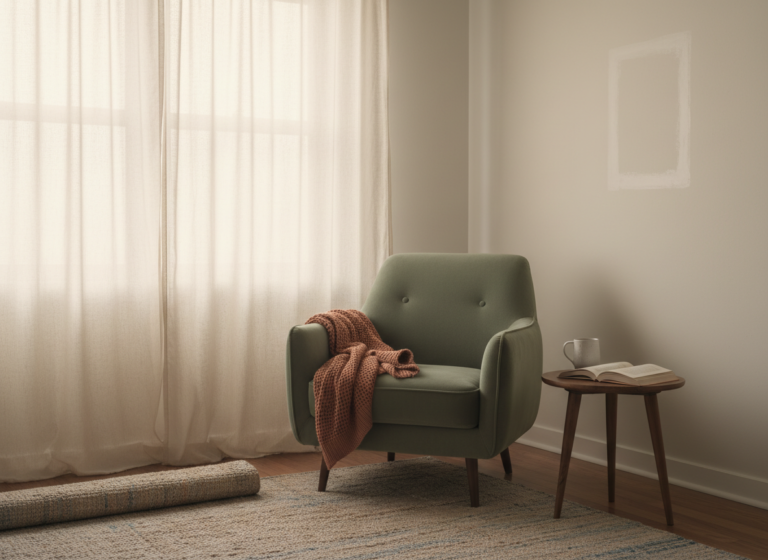
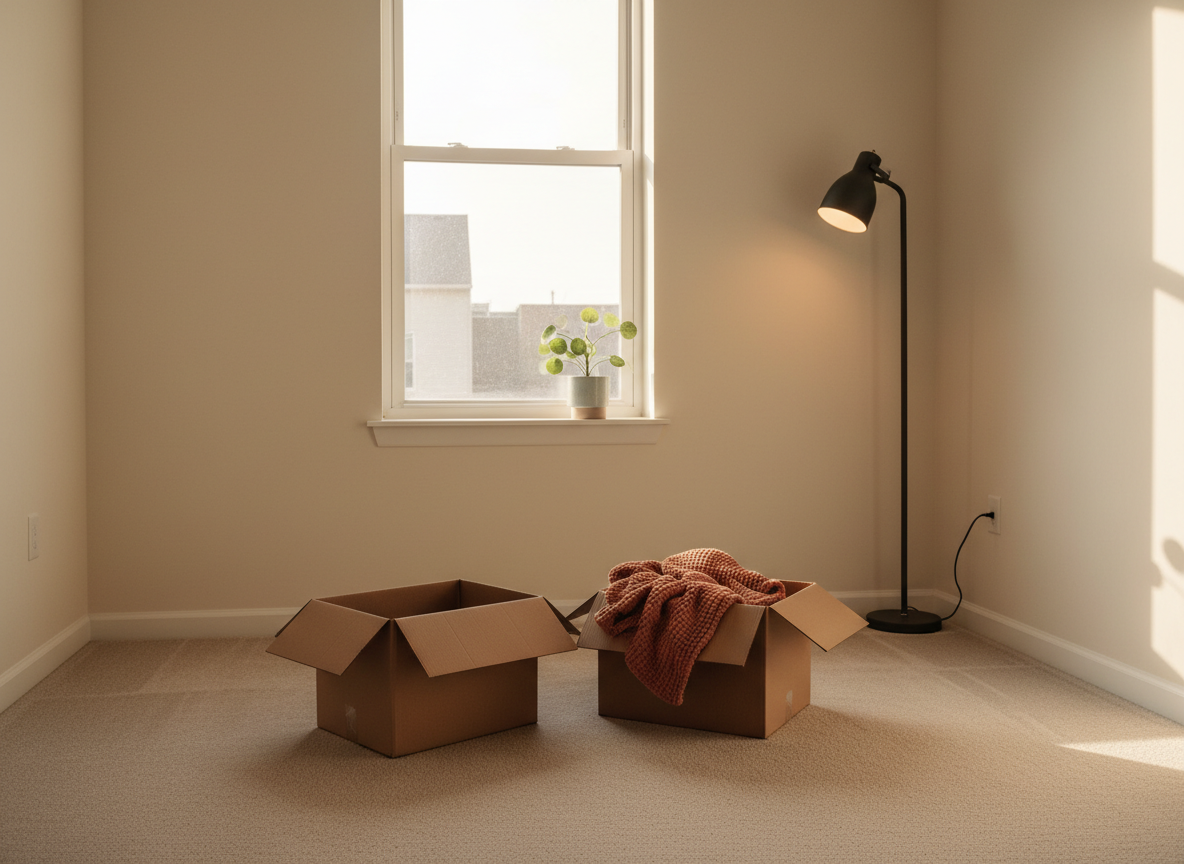
The first apartment that was finally mine — not a sublet, not a six-month stopgap — I spent three hundred dollars at Target on the wrong things and a thousand more two weeks later fixing what the first three hundred didn’t solve. The mattress was fine. The towels were fine. The problem was that nobody had told me the three-hundred-dollar list, the thousand-dollar list, and the three-thousand-dollar list are three different apartments. Move-in week is the only time you get to pick which one you’re building.
Most new-apartment guides hand you one priority list — bed, kitchen, sofa, curtains, in that order. That works with an open-ended budget. It does less for the renter with $300 in checking on day one, $1,000 saved for the month, or $3,000 to actually settle in. Below: the same apartment as three shopping lists, with the trap to skip at every price.
Why tiers beat priorities for move-in week
A priority list works when you already know your budget. Most first-apartment renters don’t — the number moves week to week as the security deposit clears, the first paycheck lands, and the unexpected utility setup fee shows up. Committing to one version of the apartment at a time, finishing it, and deciding whether to upgrade later is the move that protects you from the priority-list trap.
The trap looks like this: you buy the $1,000-tier sofa first because “sofa was item one,” then run out of money before the curtains and lamps. The room ends up with a beautiful couch in an empty, fluorescent-lit space. A $300 sofa with $300 curtains and a $300 floor lamp feels more finished than one $1,000 sofa with bare windows. Match the tier across the room before you upgrade any one category.
If your budget is flexible and the timeline is slow, our priority shopping list for a new apartment still applies — that’s the version where category order matters more than tier. The framework below is for everyone whose budget changes between Tuesday and Friday.
| Category | $300 tier | $1,000 tier | $3,000 tier |
|---|---|---|---|
| Sleep | Mattress topper on floor, 2 pillows, sheet set | Mattress + IKEA Malm frame | Mattress + frame + headboard + nightstand |
| Sit | Floor cushion + folded throw | Used loveseat from Facebook Marketplace | New sofa + one accent chair |
| Light | One floor lamp, 2700K bulb | Two lamps + warm bulbs | Three lamps + one statement fixture |
| Window | Tension-rod blackout curtain (bedroom only) | Curtains on every window | Layered curtains — sheer + blackout |
| Floor | Nothing | One 5×7 jute rug | 5×8 wool-blend rug + runner |
| Eat | Microwave, kettle, thrift plates | Folding table + 2 chairs | Dining table + 4 chairs |
| Wall | Nothing | One leaning printable + thrift frame | 3-piece printable set, all framed |
$300 — the 14-day version
Three hundred dollars is the bare-minimum tier. The goal isn’t to make the apartment look decorated. It’s to make it functionally livable for two weeks while the rest of the budget catches up. Sleep, light, one window covered, basic kitchen. Nothing on the walls. Nothing on the floor.
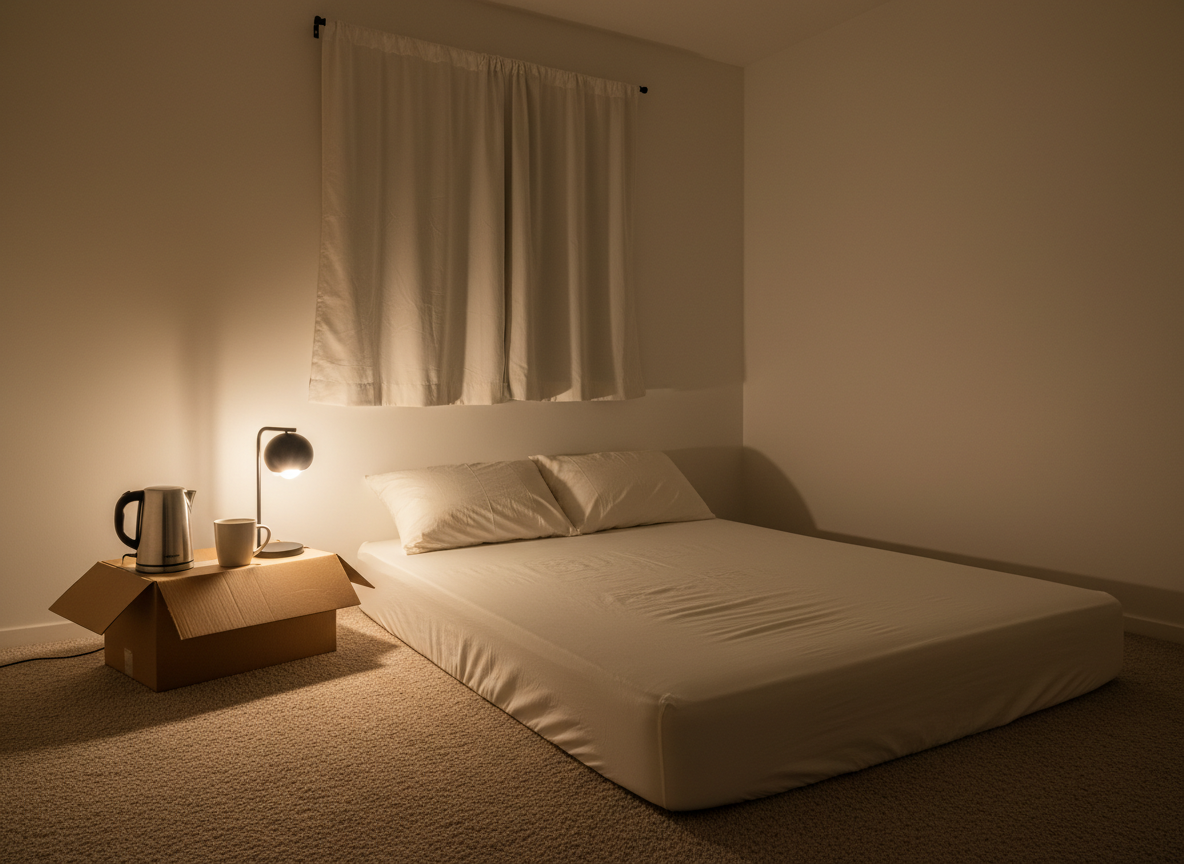
The $300 tier in week one — topper on the carpet, one warm lamp, one window covered.
Where the money goes:
- $80 Thick mattress topper (skip the actual mattress for two weeks; sleep on the topper directly on the carpet)
- $20 Two pillows
- $25 Sheet set
- $30 Cheapest floor lamp + 2700K bulb
- $35 Tension-rod blackout curtain (bedroom only)
- $20 Kettle
- $90 Plates, towels, microwave, and the things you’ll need by Friday — shower curtain liner, trash can, soap dish
The trap at this tier is buying anything decorative. Not one print, not one plant, not one throw pillow. Every decorative dollar here is a dollar you’ll need for the $1,000 tier two weeks later — and the apartment looks worse with one cheap framed print on a bare wall than it does with the wall left clean. Decorative spending starts at the $1,000 tier. Until then, the room reads as “in progress,” which is honest and forgivable.
One aside, since it cost me a Saturday to learn: thrift shop for plates, never for towels. Plates survive a dishwasher; towels don’t survive a previous owner. The first apartment I furnished I did the opposite and regretted exactly one of those choices.
$1,000 — the version that stops borrowing
A thousand dollars is the tier where the apartment stops asking the world for help. The mattress isn’t on the floor anymore. A sofa exists. There are curtains on every window. The kitchen has a small table and two chairs. The room is finished enough to invite someone over without explaining what stage of the project you’re in.
Where the extra $700 goes on top of the $300 base:
- $250 Real mattress + IKEA Malm frame
- $200 Used loveseat from Facebook Marketplace (used IKEA frames go for $80–$150 in most cities)
- $80 5×7 jute rug
- $100 Curtains on the remaining windows
- $50 Folding table + two chairs
- $20 Leaning printable + thrifted frame for the one wall worth touching at this tier
The tier-by-tier rule, written down: don’t upgrade any one category more than one tier ahead of the rest of the room. A $1,000 sofa in a $300 room reads as a thrift-store collage. A $300 sofa in a $300 room reads as a chapter. The instinct to splurge on one statement piece is the instinct that finishes the apartment six months later than it should.
The other thing the $1,000 tier buys is the first read on what comes next. Live in the $1,000 version for a month and you’ll learn which two categories you actually use enough to upgrade — and which two are fine at $300 forever. Move-in week itself can’t tell you that.
$3,000 — the version you stop calling temporary
Three thousand dollars is where the apartment becomes the place you’re not planning to leave. Not necessarily forever — but for the lease. The sleep setup is full. There’s a sofa, an accent chair, a layered rug, a real dining table for four. Lighting is three warm sources, enough to skip the overhead. Walls have art that was chosen, not just available.
Where the extra $2,000 over the $1,000 tier goes:
- $400 Upgrade sleep — real frame, headboard, small nightstand
- $600 New (not used) sofa + one accent chair
- $300 5×8 wool-blend rug + a runner
- $200 Layered curtains — sheer under blackout
- $200 Dining set with four chairs
- $150 Third lamp + a single ceiling fixture swap (most rentals allow this if you return the original at move-out)
- $150 Actual wall art across two or three rooms
Wall art is the line item that quietly changes a whole room’s tier. A 3-piece set from a digital wall art collection runs about $15 for the files plus $30–$60 to frame at Michaels or with thrifted frames. Three matched prints across one wall pulls a room into the $3,000 tier faster than any single furniture upgrade — and the same collection re-uses across rooms.
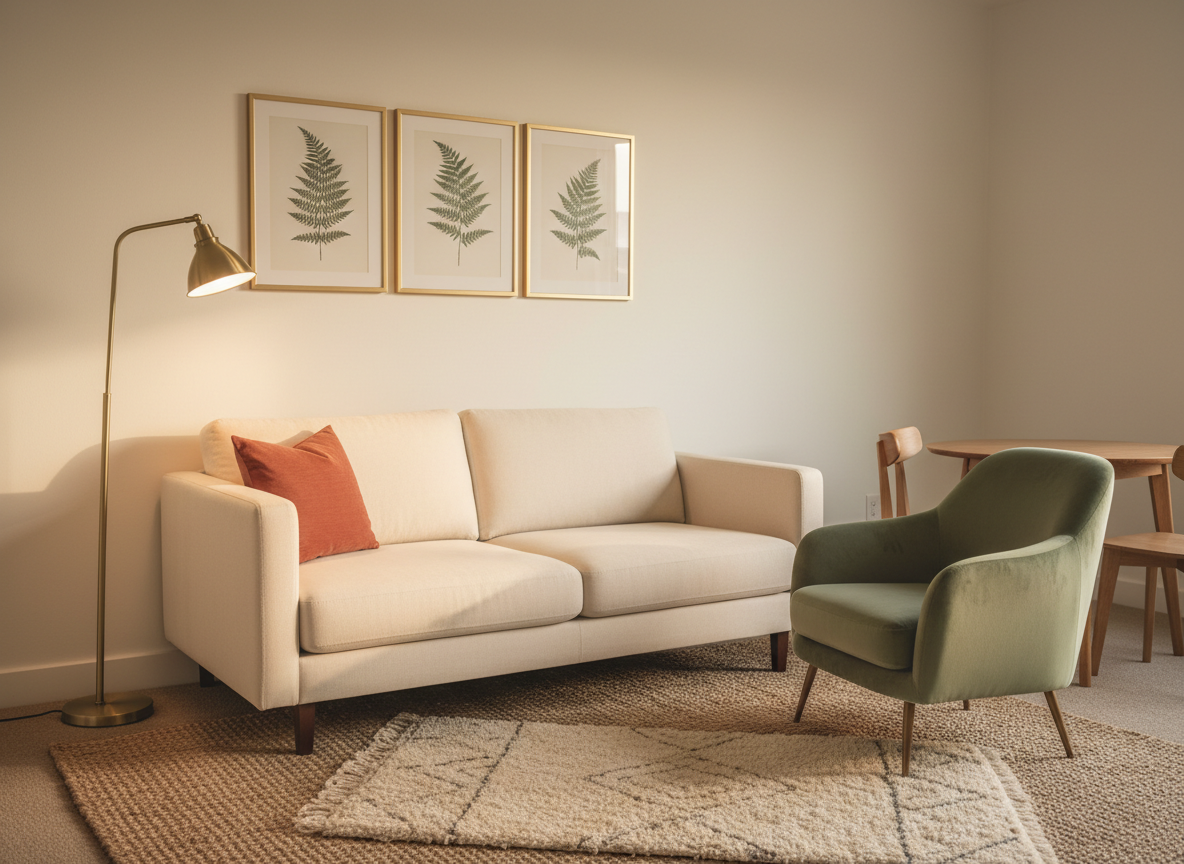
The $3,000 tier in week eight — layered rug, three matched prints across one wall, three warm light sources.
The hidden cost at every tier is the surprise spend nobody lists — trash can, shower curtain liner, lightbulbs for fixtures the previous tenant left empty, dish soap, extension cord, rug pad. About $80 at the $300 tier, $150 at the $3,000 tier. Add a 10% buffer to whichever tier you’re building. The version of move-in week that gets the budget right is the one that sees these coming before the receipts arrive.
That first $300 apartment ended up costing me $1,200 by the end of the first month, because I’d treated the move-in spend as one ambiguous category instead of three planned tiers. The third apartment, I built the $300 version first, lived in it for two weeks, then deliberately upgraded to the $1,000 version over the next month. Same total spend. The difference was that the second time, I knew which weekend the sofa was arriving.
$39 / year — join.cozyclub