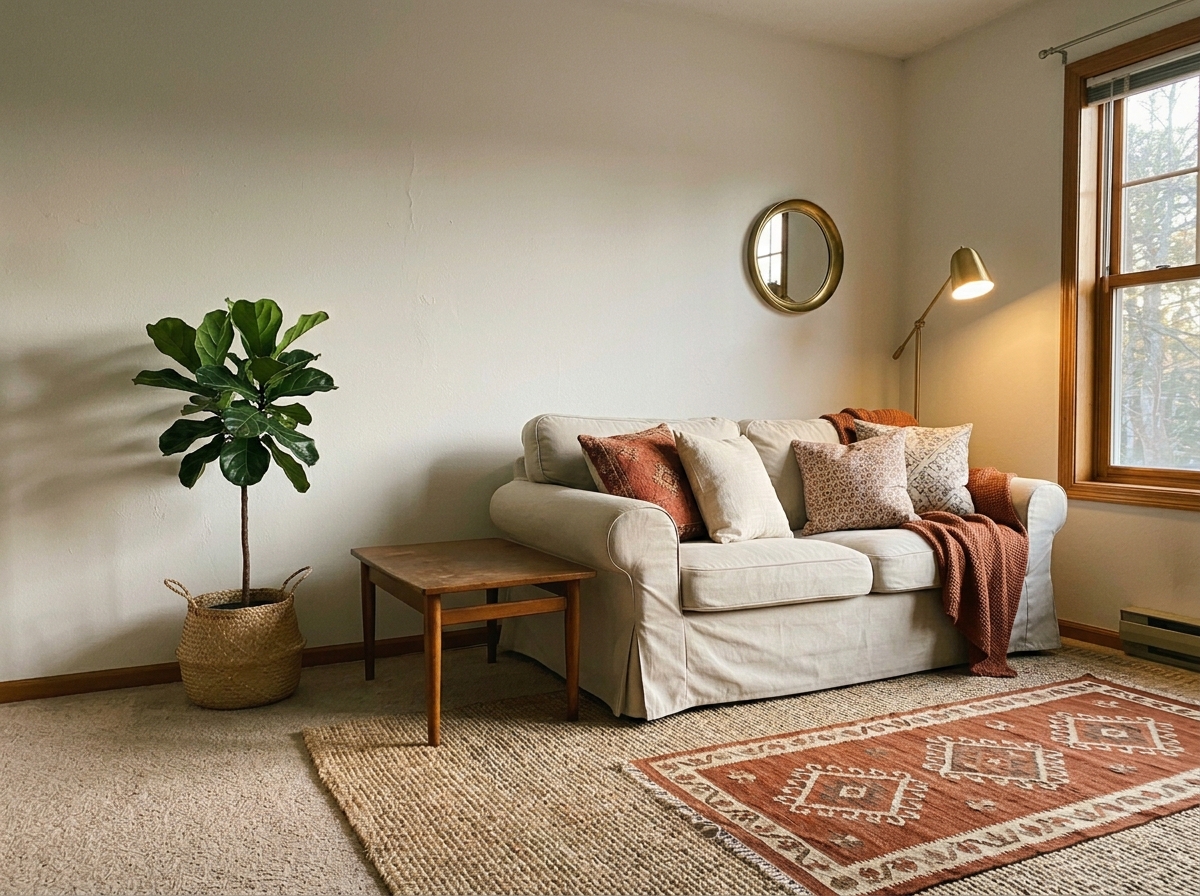
The fourth apartment I moved into had off-white walls, a beige carpet I wasn’t allowed to replace, and a single overhead light fixture that flattened the whole living room into one tired note at 6 p.m. I had a jute rug, two pothos, a macrame piece from the apartment before, and about $180 to make it feel like somewhere I’d want to come home to. By the end of the weekend it read as boho. None of the visible spend went into the walls.
That’s the actual mechanics of boho on a renter budget in 2026 — and it’s a different shape than the version of boho the style guides described five years ago. The look hasn’t really changed. What’s changed is where the budget pressure sits: textiles got more expensive, plug-in lighting got dramatically better, and walls are the easiest part of the room to leave alone. If you’ve read the original boho-on-a-budget style guide, treat this post as the update — three places to put your money and one place not to.
Walls: the part you almost don’t decorate
Boho doesn’t fight wall color. That’s its quiet superpower as a renter aesthetic. Cream, off-white, the slightly-yellow-white that every rental seems to have, even the dusty beige that landlords love — all of them sit fine under boho’s warmth, because boho’s center of gravity is below eye level. The rug, the sofa, the low shelf, the floor cushion. The wall is backdrop, not feature.
So the wall budget should be small and the wall plan should be lazy in the deliberate sense. One leaning piece against the wall behind a sideboard or a low credenza. A long, light scarf or kantha quilt pinned along a picture rail or hung on two Command hooks. A wide-format printable in a thrifted frame, sized two-thirds the width of whatever furniture sits below it. Done. The point is not to fill the wall — it’s to anchor the corner the wall belongs to.
The original boho post lists “no nail holes” workarounds in depth. The 2026 update I’d add: stop trying to do gallery walls in boho. Gallery walls want symmetry to read as a deliberate composition. Boho wants the opposite — one piece, leaned or low, surrounded by everything else doing the actual work.
Textiles: where the money actually goes
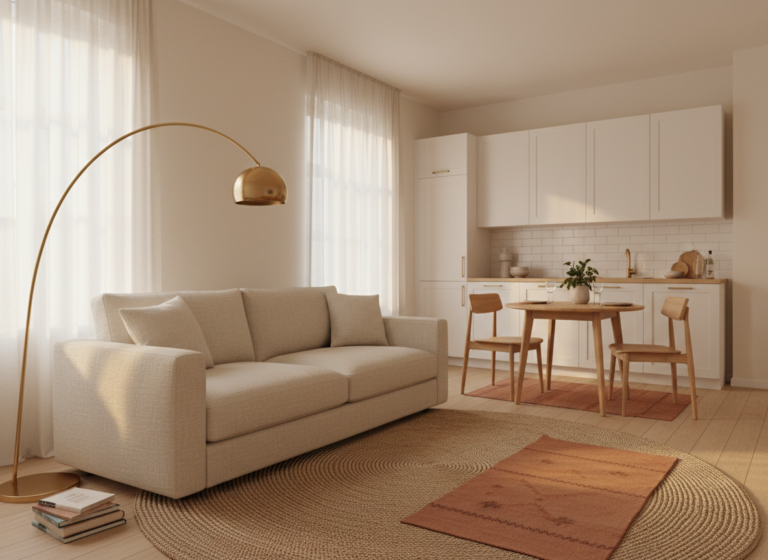
If walls are the cheap part, textiles are the part that quietly absorbs most of the budget — and the part that turns “I bought some boho things” into “this room reads as boho.” The rule that’s served me across four apartments is three textures, three heights. Three different fiber textures in the room: jute or sisal at the floor, woven cotton or linen at seating height, soft wool or kantha at throw height. Three heights they live at: rug under furniture, slipcover or cushion on the furniture, throw draped over the back or the arm. Hit those nine slots and the room reads layered before you’ve added a single decorative object.
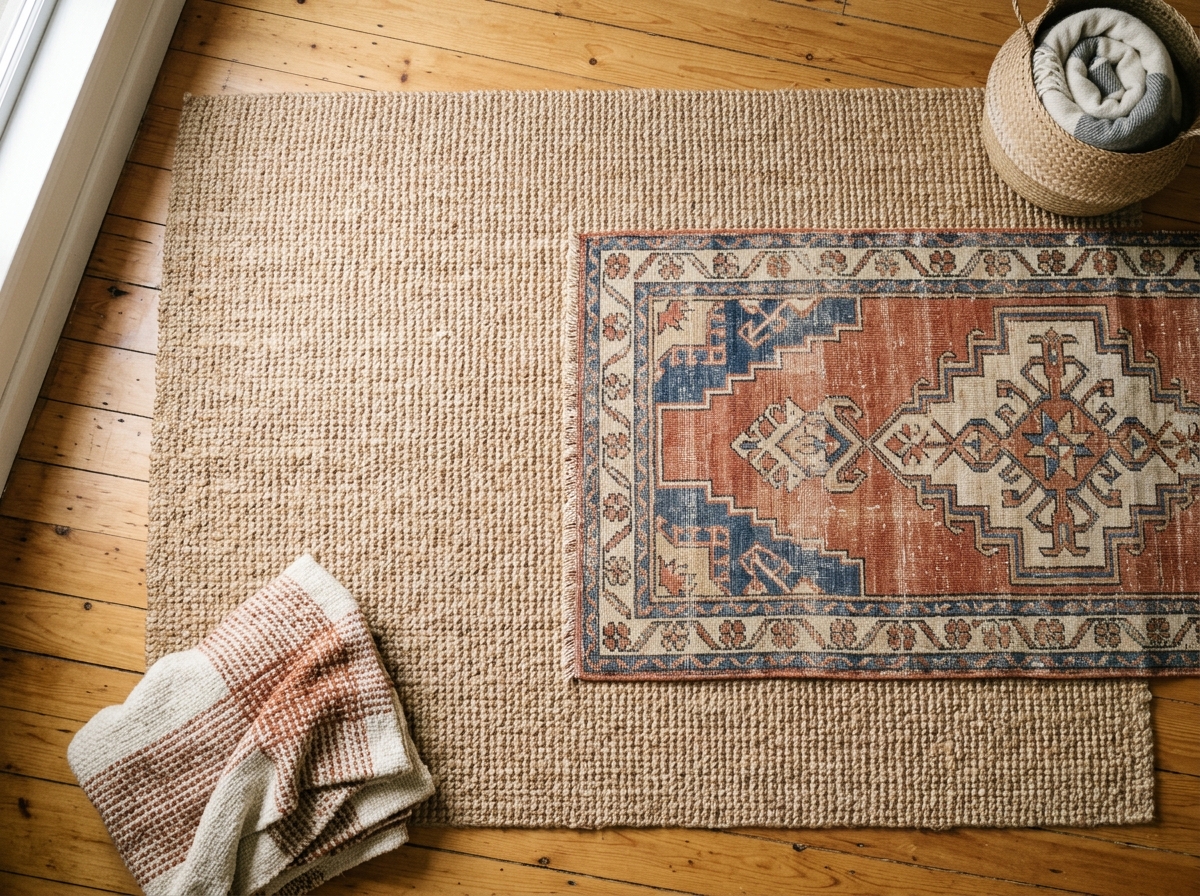
The 2026 budget pressure point: large boho rugs (8×10 jute, 5×8 vintage-look kilim) doubled in price between 2023 and 2025. The workaround most renters land on by accident is the layered-rug move — a small affordable patterned rug on top of a larger plain natural-fiber base. The base is utilitarian (jute, sisal, low-pile wool, ~$150–$220 for an 8×10), and the top piece is the personality (a 3×5 kilim or vintage Turkish runner, $60–$120 used). The layering does two things at once: it lets you change the personality piece without buying a whole new rug, and it doubles the texture count in the floor zone without doubling the spend.
One small rule that makes layered rugs read intentional instead of accidental: the top rug should cover roughly one-third to one-half of the base rug, offset toward the seating area, not centered. Centered reads like you ran out of space. Offset reads like a choice.
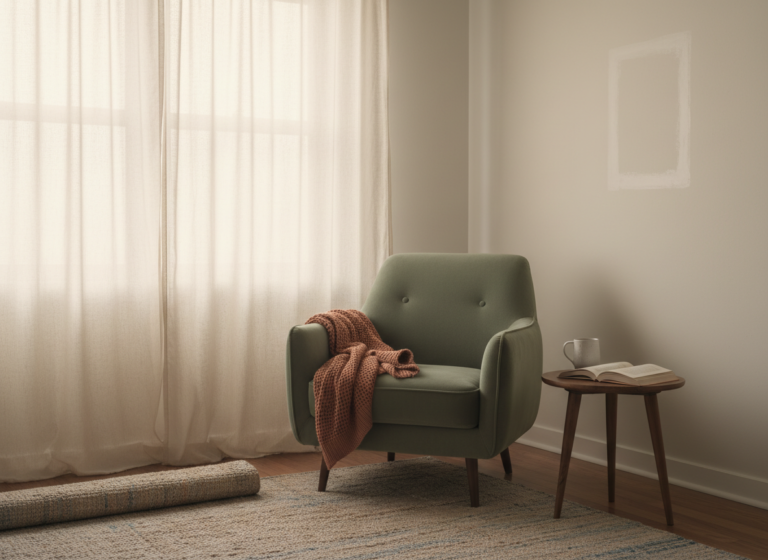
The trick that surprised me most: a folded throw on the back of the sofa adds more visible “boho” than a $200 wall piece. The throw is at eye level when you sit down, it shows three colors in a small area, and it can be swapped for $40 every season. The wall piece can’t.
Light: the dimension renters keep getting wrong
The single biggest difference between a boho room that works and one that almost works is the light. Most rentals come with a flat, cool overhead fixture in the center of the ceiling — sometimes a single bulb, sometimes a fan-light combo, almost always at 4000K or higher. Boho is a warm aesthetic. 4000K kills it before any of the textiles get a chance.
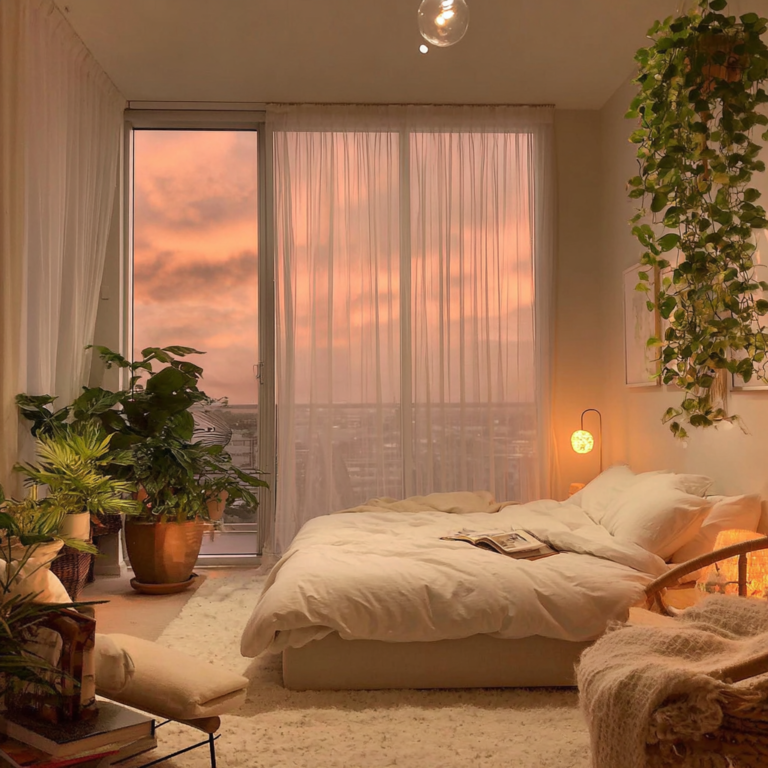
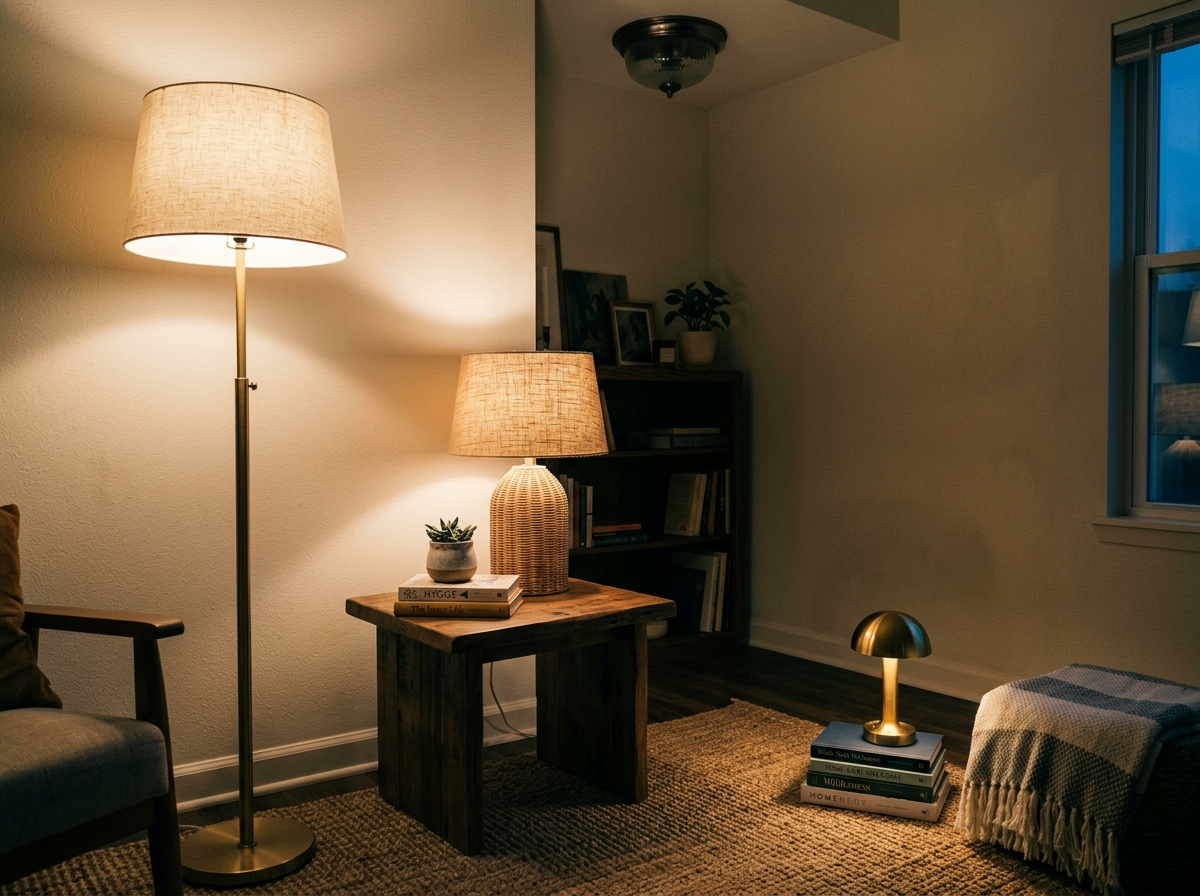
Three moves, in this order. One: swap the overhead bulb for a 2700K warm-white smart bulb ($12 each, lives in your move-out box). Two: add a plug-in pendant or sconce somewhere off-center — a rattan or woven pendant on a 12-foot cord run along the ceiling and pinned at the corner, plugged into a wall outlet. No electrician, no security deposit risk. The cord-along-the-ceiling look is itself part of the aesthetic; the trick is to commit to it visibly instead of trying to hide it. Three: the lamp triangle — three lamps at three different heights in the same room. Floor lamp in one corner, table lamp at mid-height on a side table, low lamp or candle on the floor or low shelf. The eye reads the triangle as warmth distributed; flat overhead light reads as institutional.
This is the dimension the original style guide undersold. You can do everything else right — the layered rugs, the textured throws, the leaned art — and a 4000K overhead bulb will undo all of it in the first hour after sunset. Fix the light first, then the rest of the room costs less to look right.
| Layer | Where the 2026 budget goes | Where it doesn’t |
|---|---|---|
| Walls | One leaned piece, sized to furniture below | Gallery walls, matched frame sets |
| Textiles | Layered rugs, throws, slipcovers, cushions in mixed fibers | One expensive “statement” rug |
| Light | 2700K bulbs, one plug-in pendant, three lamps at three heights | Whatever fixture came with the rental |
Boho on a renter budget isn’t a style — it’s a budget strategy that happens to look like a style. It works because it puts the money in the parts of the room you can take with you, and asks almost nothing of the parts you can’t.
The reason the aesthetic survives apartment to apartment is that the parts that carry the look are the parts that travel. A jute base rug, a folded kilim, two throws, three lamps, one leaned piece. Five apartments from now those things will still read as a room. The walls will be a different color, the carpet will be a different color, the overhead fixture will be a different shape. None of it will matter.