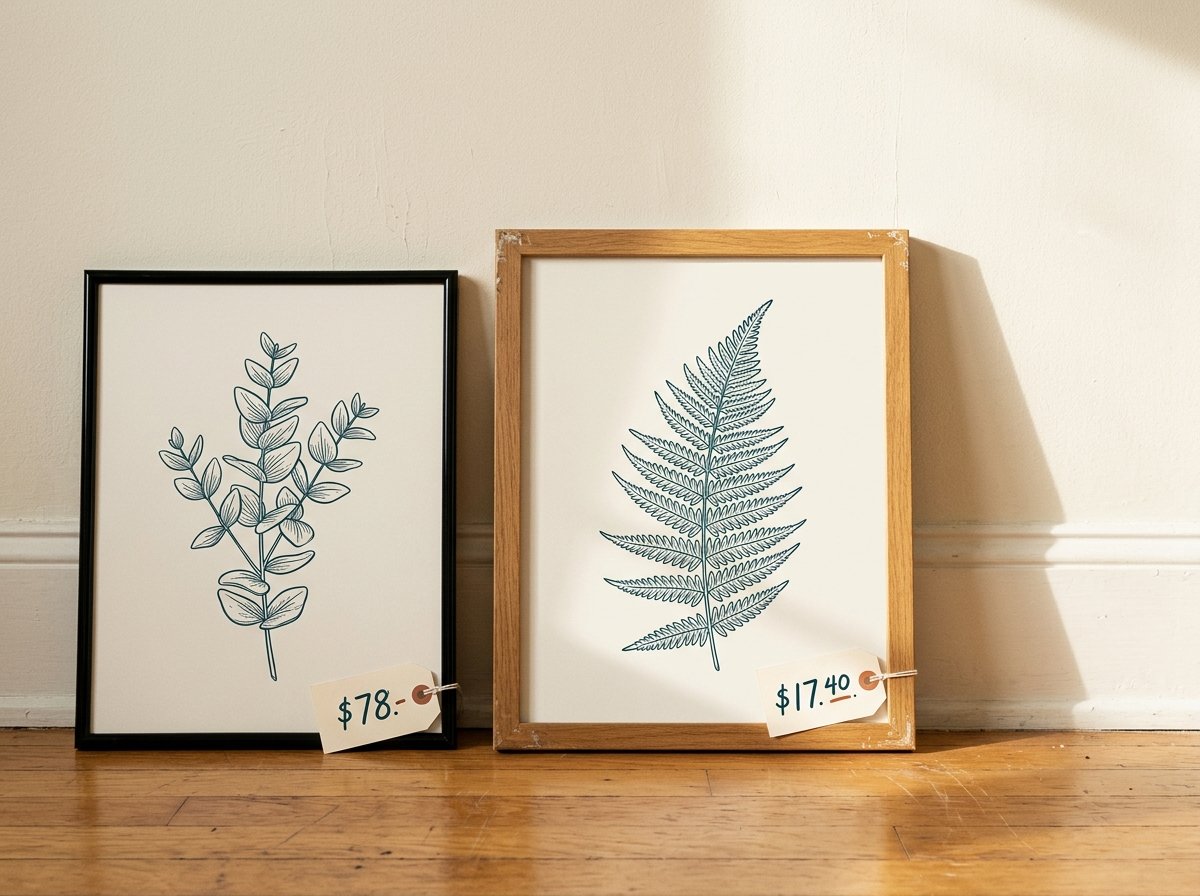
That gap is what this post is actually about. Not “digital art is cheaper” — everyone knows that. The interesting question for a renter is what the full, finished, on-the-wall cost looks like in 2026 once printing, paper, frame, and the inevitable accidents are counted. And whether the math still favors digital when the renter timeline (move every 18–24 months, lose at least one frame per move) is included. The short answer is yes, but with a couple of cases where mass-produced still wins.
The 2026 cost gap, line by line
The honest comparison isn’t “$5 digital file vs $78 store print.” The honest comparison runs the digital print all the way to a framed object on the wall. Here’s what that costs in 2026 for a standard 11×14 print, the size most renters land on after one or two attempts at hanging anything bigger.
| Line item | Digital printable | Mass-produced retail |
|---|---|---|
| The art itself | $5–15 (file, instant download) | $25–90 (HomeGoods, Target, World Market, Wayfair) |
| Print + paper | $3–7 (Staples, FedEx Office, local copy shop, 11×14 matte) | $0 — print included |
| Frame | $7–25 (IKEA RIBBA $14.99, Target Threshold $12–20, thrift $3–8) | $0–30 (often frame-included; if not, same as left column) |
| End-to-end on the wall | $15–47 | $25–120 |
The gap narrows at the low end and widens fast at the high end. The interesting cell is the middle row: print cost. A lot of “digital art is so cheap” posts skip it. In 2026, a single 11×14 matte print at a chain shop runs $5.49 at Staples, $6.99 at FedEx Office, $3.50–5 at independent copy shops. At-home printing is competitive only if you already own a decent inkjet; cartridge cost per print is closer to $4 anyway. Most renters skip the printer entirely.
When mass-produced still beats printable
Three cases where the math flips and mass-produced is the smarter buy. None of them are about taste — they’re logistics cases.
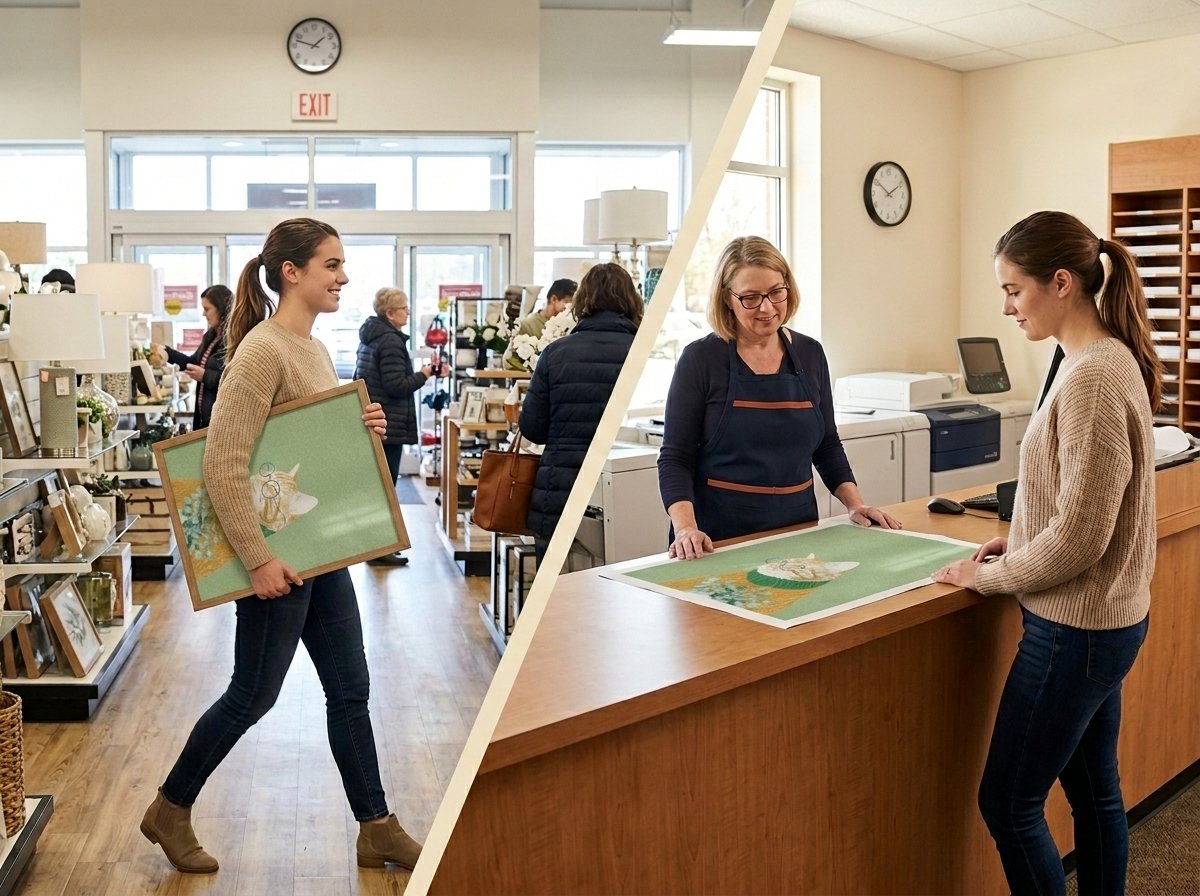
You need it on the wall this weekend. A printable bought Friday night still needs a Saturday print-shop trip, an IKEA stop, and twenty minutes of mounting. If the wall is bare for a Sunday brunch, a $40 framed print walked out of HomeGoods in twenty-eight minutes is the move. Time has a price; sometimes the price is $25 over the digital total.
The exact piece you fell in love with is already framed. If a specific print at World Market is the one that speaks to you, buy that one. The renter-math case for digital is about the average piece on the wall, not the specific piece you can’t stop thinking about. Don’t print a “close enough” alternative to save $30.
You’re furnishing a sublet or four-month stay. When the apartment is short-term, the time investment of printing and framing doesn’t earn its return. A $20 store-bought framed print, used hard for four months then donated, beats a $14 digital that needs an hour of setup and another of de-installation. Match the investment to the lease.
The renter math — why the file outlasts the frame
Here’s the line the price-tag comparison misses. A mass-produced framed print is one object, hung once, in one apartment. A digital file is the same art, ready to be reprinted at the next apartment in a different size, or re-framed when the old frame chips a corner during a move, or reused as a desktop wallpaper or a phone lock screen in the meantime. Spread the digital cost across three apartments and the per-apartment cost drops below $6. Spread the $78 framed print across the same three moves and the per-apartment cost is $26 — assuming the frame survives all three, which it usually doesn’t.
The single biggest hidden cost in mass-produced art for renters is the move. Glass frames crack in the back of a U-Haul. Replacing one cracked 16×20 frame is $22–35; replacing the entire framed print because the cracked glass scraped the print beneath is the full $78 again. With a digital file, the failure mode is one $14.99 IKEA RIBBA and a re-print. The art itself doesn’t crack.
What a renter actually pays per apartment for one 11×14 piece (3-move average)
Multiply by the eight to fifteen pieces a fully decorated rental ends up with and the cumulative gap is the cost of a small piece of furniture, not pocket change. The file outlasts the frame, the lease, and most of the prints in the apartment.
Where to start if you’ve never bought a digital print
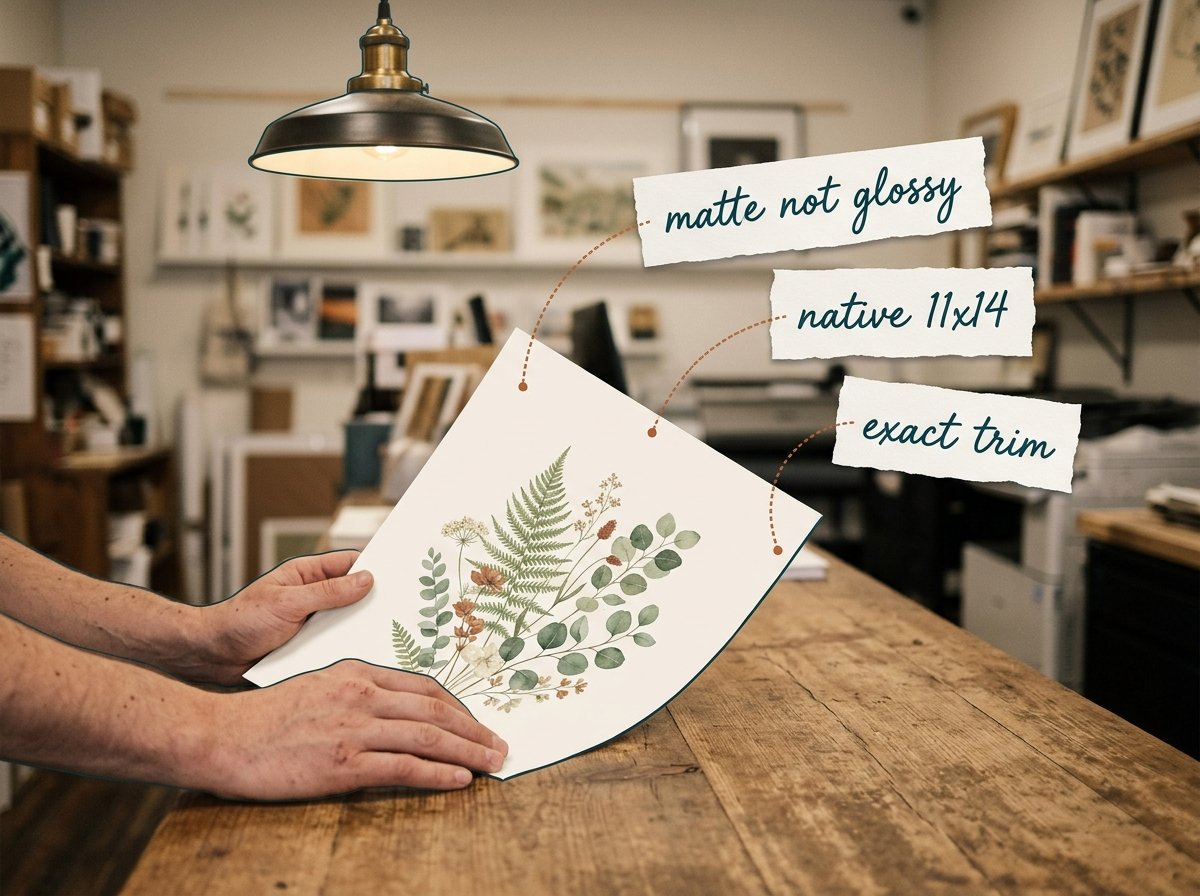
The friction is usually the printing step, not the buying step. The buying step takes ten minutes and a credit card; the printing step is where most renters stall because they’re not sure which file to send, what paper to ask for, or how to handle the file at the shop. Three things to ask the print counter that head off the typical first-time mistakes:
“Matte paper, not glossy.” Glossy prints reflect overhead lighting and look cheap on a wall; matte reads like an art print. Most chain shops default to glossy unless asked. “Print at the file’s native size, not scaled to fit.” A digital file at 300 DPI is sized to print at a specific dimension; scaling it down compresses detail, scaling up softens edges. “Trim to the exact dimension, not standard letter.” The frame is 11×14; the print needs to be 11×14, not 8.5×11 floated inside a mat.
For frame sourcing in 2026, three reliable defaults: IKEA RIBBA at $14.99 for 11×14 in black, white, or oak, Target’s Threshold line for warmer wood tones at $12–20, and the local thrift store, where solid wood frames in the same sizes routinely show up for $3–8. Skip the white plastic frames at the dollar store — they’re the single fastest way to make a beautiful print look cheap.
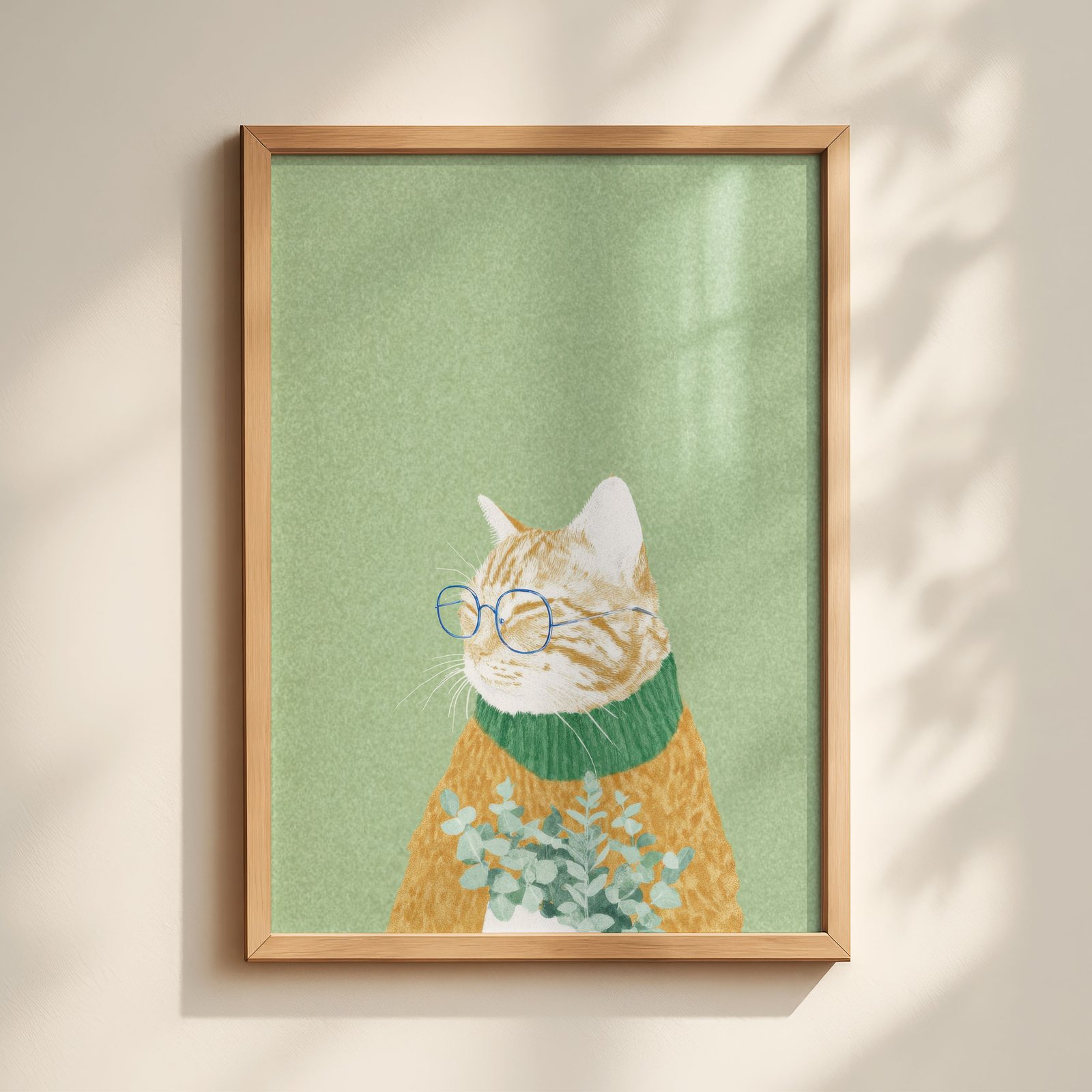 The biggest barrier to digital art for first-time buyers isn’t price. It’s confidence that the finished piece will look as good on the wall as the framed retail option. It does. The gap closed years ago; the price hasn’t. Browse the full digital wall art catalog — twelve collections built specifically for renter walls, every file at print-ready 300 DPI in five standard sizes — and pick one piece to test the workflow. Total investment to find out whether digital actually works in your space: under $20.